Showing posts with label Peter Paul Rubens. Show all posts

Monday, 18 November 2013

French Rococo Painting

Taking the timeline of Baroque to Neoclassical art over to France during the reign of Louis XV (1715-1774), a style developed called Rococo. The name derives from the French 'Rocaille' to describe rock-like motifs which extends into scroll-like and shell-like motifs. The style is described as a lighter, less religion based Baroque. Louis XV was the grandson of his predecessor Louis XIV. Louis XIV stipulated in his will that his grandson should become king but shall not rule until he came of age. Before then, his nephew, Philippe of Orleans, would be the president of a Regency Council that would rule by majority. By 1723 the Regency ended and the 13 year old Louis XV became king.

Louis XIV employed academicians as his court painters, such as Poussin, of whom I wrote about here. During Louis XV's reign however, the influence of the low countries meant that French painting changed direction. Although Louis XV patronised this new style, the academicians still held their ground. The academicians, known as the 'Poussinists' were rivals of the Rubenists - those of whom followed (or painted with influence from ) the 17th century Flemish painter.

Some artists that could be described as 'Rubenists' that introduced the Rococo style:

Watteau, Embarkation for the Island of Cythera, 1717.
The island of Cythera was known as the island of Venus. The painting is dream-like, with a particularly Venetian palette. The wistfulness of the figures and the less precise brushwork has clearly been lifted from Rubens' Garden of Love (pictured below). The dimensions of this picture are 1.3m x 1.9m which is typically quite big for paintings that fell outside of the history painting genre. It is without a religious or moral meaning but is a 'fete galante' - which was basically a French party during the regency. Because of the difficulty in attributing it to a genre, the 'fete galante' became a genre of its own.


Pierrot, 1718-20.
During the reign of Louis XIV, Watteau was employed by the painter Claude Gillot whose paintings were a reaction against academic art. Here he was able to see a lot of Rubens' work but more importantly with reference to this painting he became well acquainted with characters from the 'Commedia dell'arte'. The 'comedy of craft' was a set genre of theatre which was expelled from France at the beginning of the 18th century and of which Pierrot was a character. My lecturer always says that we are 'children of the romantic era' and tend to assume paintings like this show sadness and loneliness, but he believes that may not be the case - maybe just a painting of one of his favourite characters.


Fetes Venitiennes, 1718-19.
This painting depicts Watteau's friend, and art dealer, Vleughels. He is the one in the turban. The palette is of course Venetian once more. The people in the painting are happy, flirting and listening to music. There is a sense of sensuality and harmony typical of the Rococo. Watteau has also painted a life-like sculpture to the right. The brushwork is again loose and sketchy like Rubens.

L'enseigne de Gersaint, 1720.
This is a painting of the art dealer Gersaint's shop. As above, the interaction between the figures is plentiful and flirtatious. This is quite symbolic as a change in artistic tendency - the figures are packing away austere, baroque art into boxes.

Boucher, the Rising and Setting of the Sun, 1752-3.
This one shows a slight return to moral painting. The characters are perhaps representative of Louis XV and Madame Pompadour. Louis XV as apollo is perhaps an allusion to his relation with the 'sun king' (Louis XIV). It is a baroque-ish subject mattere with baroque-ish harsh movement. Saying that, it's baroque qualities have been rococo-fied in its beauty, easy and sense of calm.

Mile O'Murphy, 1752.
My lecturer talks a lot about being able to identify different art styles through 'tits & bums' - Rococo bums are not as sculpterly as renaissance or baroque bums but not as dimplely (lol) or flat as avant-garde bums. Her foot laying of a fluffy pillow is probably meant to echo her fluffy rococo bum and is typically playful as was rococo art. With the unmistakable pinkish-orangey tones.

Frangonard, The Swing, 1767.
Hogarth's secret of beauty was that it 'leads the eye a wanton kind of chase' - i would say this applies here. She has a slipper flying off, there's a curling tree branch over her head and of course she is on a swing - a sense of letting go and being at ease. 

Coresus Sacrificing Himself to Save Callirhoe, 1767.
Perhpas at first this doesn't look as calm and at ease as the others, but the little putti to the right and the way in which the sacrifice could be mistaken for something other than killing yourself are tell-tale signs of rococo. 

Chardin, the Young Schoolmistress, 1735-40.
This looks like Dutch genre scenes but the refined and Venetian brushtroke gives it the quality of the French rococo. Although Chardin was influenced by the Dutch and Venetian like the other rococo painters, his work is characterised by the sense of Bourgeoisie morality that he perhaps picked up from the Netherlands too. It wasn't like the baroque whereby the sense of morality was geared towards the upper class of whom concerned themselves with dangerous, unorthodox pit-falls. It was about life, and the need to be learned for example. In rococo style though, the schoolmistress is neither harsh nor demanding - she is patient and kind. 

The House of Cards, 1735-6.
This is another typical morality piece. The young boy is acting like an adult in his adult clothes, but as a house of cards may fall easily, his demeanor may deteriorate too - a lesson in acting prudent.

The Attributes of the Arts, 1766.
This obviously has a lot of still-life influence from the Dutch.  Chardin wanted to be taken seriously and this was actually accepted into the academy. It shows a sculpture by his friend, Pigatte (of Mercury), books and the Order of St. Michael award that was awarded to artists. 


Thursday, 8 August 2013

Flemish Painting in the 17th Century

Right, so at the beginning of our timeline (16th century) the Netherlands belonged to the Kingdom of Spain. In 1568 7 very brave provinces rebelled against their ruler and after successfully creating their own little autonomous states they signed the Union of Utrecht to become a unified entity. This was the beginning of the acclaimed 80 years' war (it gets more confusing, there's a 30 years' war in the 80 years' war; so well acclaimed and given its own name because the whole of Europe got involved). Baroque

Phillip II wasn't too pleased and started a campaign to retrieve his lost territories, but was interrupted when the Anglo-Spanish war began (1585-1604). The Flemish took advantage of this distraction and were soon to siege Antwerp, defining the north/south divide. Therefore this takes us to the beginning of the Baroque period (circa 1600-1750) in the Netherlands. Where the scene was set for an autonomous northern Flanders and the southern Spanish Flanders. The north still wanted an absolute republic without the fear of Spain looming over them.

During the 80 years' war (or otherwise 'period of hostility'), there was what is known as the 12 year truce from 1609 onwards. There was an agreement made in Antwerp (Amsterdam) which put a hold on any hostile behaviour. In the Dutch series of events, Spain actually agreed for them to be declared a republic, but as is life the Spanish insisted that they only said that they may ACT as IF they were one. What this meant for the southern Flanders is that they were firmly under Spanish Catholic control without any annoying intervention; while the rest of the Flanders had free range to believe, do and trade to their hearts content. Makes for the perfect environment for an artist (lots of commissions!) which Rembrandt took advantage of.

Of course, this truce only lasted for 12 years, there was a failed attempt in 1621 to renew the truce - a bit of a lost cause considering a European-wide war had broken out that was to last 30 years. (Began out of the tension between the Protestant/Catholic countries; continued because of an array of political reasons). At the back end of this war however, was the Dutch Golden Age. The Netherlands gained recognition as a republic from the Spanish crown after the 1648 treaty 'Peace of Westphalia'. This was good news for the Netherlands, their important ports of Bruges, Ghent and Antwerp assured a wealthy country was to emerge. Alongside this, they were able to resume to their activities with the Dutch East India Company that they had established way back in 1602 (they weren't exactly compliant with Spain, they went about their colonial expansion business as normal!).

A Dutch East India Company official and his wife, with slave & view of Batavia, Java 1640-1660, Albert Cuyp


Peter Paul Rubens

Marchesa Brigida Spinola 1605


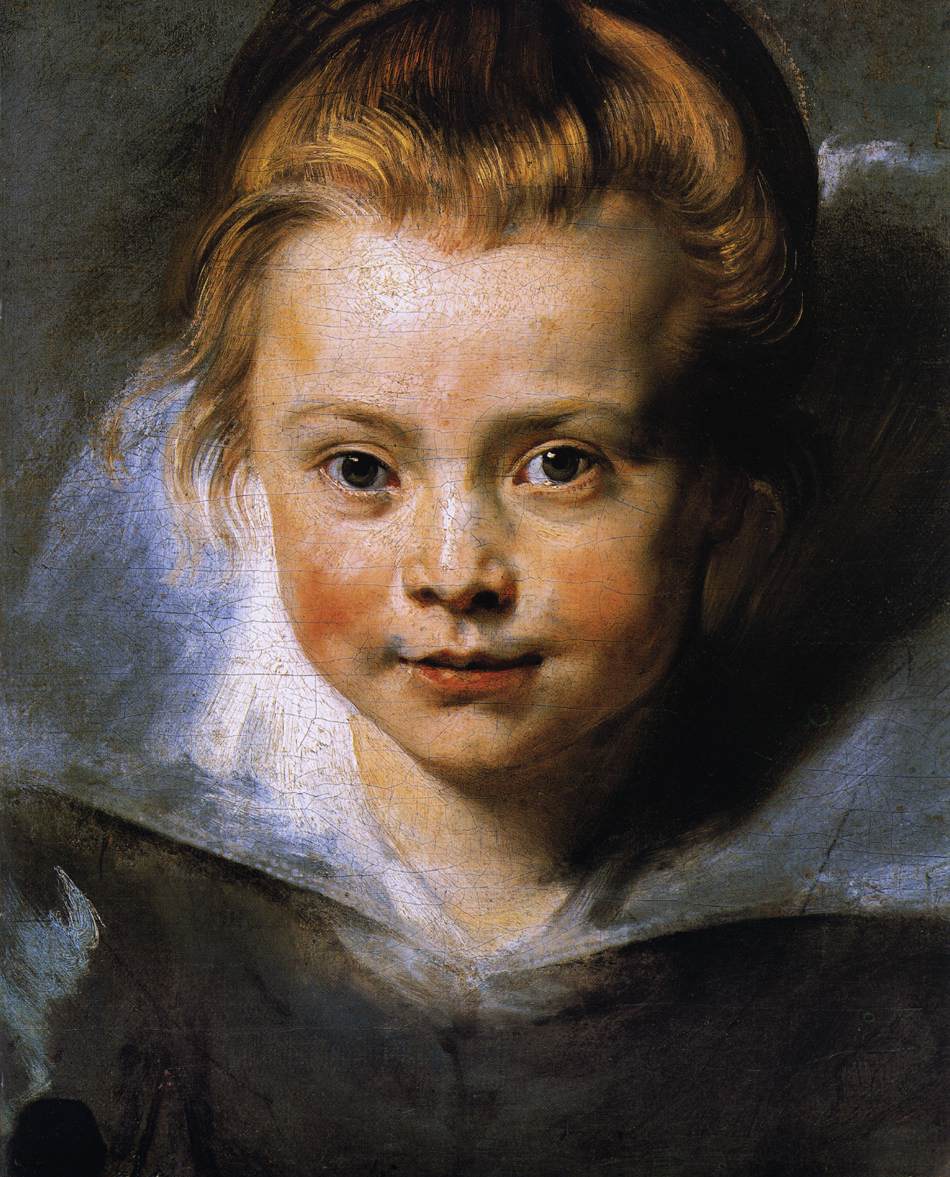
Portrait of Clara Serena Rubens 1616
In comparison to his earlier portrait, his palette had became far lighter and blonder. As a man educated in Italian art, the former clearly oozes what he had observed. This one however shows his style developing into something more similar to Baroque. It's in the small details, like the little strands of baby hair implying a living quality.


The Elevation of the Cross 1610
Represents his earlier, darker manner. Beginning to see the energy breathe throughout the picture. Having studied Venetian and Florentine tradition in painting he struck a particular interest in the Venetian 'Colore'. Other than Venetian influence in terms of colour, Tintoretto also had an impact on him. This can be seen in the figures appearing to be 'sucked' into the picture much like in Tintoretto's Crucifixion (1565).

Christ, although depicted fairly muscular here, there are probably far more men then was needed to carry him! Some have attributed this to the metaphor of Christ being so heavy because of the weight of sin.

There is a very random spaniel down in the right corner, other than being an allusion to the loyalty of the men carrying Jesus, it may have also been a way for Rubens to show off his ability to paint a variety of textures. Furthermore, the tendency to mix materials (multimedia effect) was common among Baroque painters...but in Rubens case, instead mixing materials he mixes imagery with sound (the wailing of a dog). This adds to the overall 'busyness' and noisyness in Baroque painting.

Also, take a look at the Hellenistic sculpture Lacoon and Sons (25AD). It obviously had an impact on Rubens. I like to draw a similarity between the relationship of classicism in ancient Greece and the Hellenism to succeed it with the Renaissance and then Baroque.


Samson and Delilah 1609-10
Painted at the same time as above just after his return from Italy. Again, Italian influences include the Michelangelesque muscular form of Samson. He is showing off his command of drapery (her pretty dress), virtuosity (the skill in which he can paint such little details such as fingers), narrative (he's now a pro after having seen all the countless Italian history paintings) and anatomy.


An Autumn Landscape with a View of Het Steen in the Early Morning circa 1636

Landscape with Rainbow 1635


Anthony van Dyck pupil of Rubens

Self Portrait, 1620-21
Portrays himself as a courtier, and shows the same virtuosity in his depiction of hands in the same way Rubens did.


Elena Grimaldi, Marchesa Cattaneo 1623
Painted in Genoa, on his travels (Rubens went to Genoa too).


Charles I with Monseigneur de St Antoine 1633
I believe that it is with this portrait that you begin to see the Baroque style influence Van Dyck. He still has Charles I looking as courteous as ever, however the horse and person beside it imply a movement throughout the picture. I think what is more notable is the fact that the horse and person (especially the latter) are even there to begin with - begins to show the ideals of portraiture slowly changing. 


Equestian Portrait of Chales I, 1633
The beginnings of movement I mentioned before appear in full force here; There is a definite essence of Rubens in the way that the man beside the horse appears to be rushing in through the door and the curtains flying about. Seems to me like there is a force behind them - much like we'd find in Rubens' work. There is also the very obvious indication of the baroque style - baroque architecture.

A common thing among portraiture of a monarch is the tendency to highly politicise the image. Here, the shield represents the unification (the word unification MODESTLY applied) of England and Scotland and the beginning of the United Kingdom in 1603 by James I.


Charles I 1635-36
Painted in order to send to Bernini - so that he could make a sculpture of him.


Frans Hals

Isaac Massa and Beatrix van der Lean 1622
A far cry from what portraiture was in the Renaissance!! The happily married couple acting like a married couple (enjoying each others company, joking around?) instead of the Arnolfini-like portraits of the man and woman looking bored and not particularly enjoying each other at all. ALTHOUGH the example I've shown below is probably the most tender of what the Renaissance offered in marriage portraits- Flemish painting was always less harsh than Italy's. Also, this is a far more realistic depiction of a couple in general. The woman isn't idealised, as almost everyone was in the Renaissance. She ain't too pretty.


The Arches of St. Hadrian 1633
The generic elbow sticking out to include the viewer into the space!


Laughing Cavalier 1630
Is this a real person or not? or mixture of both? no one knows.
This represents Hals advertising himself as having a distinct manner, definitive, rough, sketchy, (although unlike Rembrandt's use of impasto). His technique increases the sense of vitality in the Cavalier.  The image below popped up when I was searching for the actual image ha


Judith leyster
WOMEN also benefitted from the expanding market at the same time that painting was no longer seen as inappropriate for a woman to practice. In fact, women who liked to leisurely paint and look beautiful and insightful doing so were the archetypal well behaved daughter or wife.

Self Portrait, 1635
Sense of cheerfulness, loose brushstroke like Hals.
She's shown painting a genre painting of a boy playing a violin.

The Proposition 1631
A menacing man harassing a woman. If this didn't happen to be painted by a woman then I'm certain the woman would have been LOVING this. Leyster's used the candle here in conjunction with effective Chiaroscuro to create vitality and to emphasise the movement of the man and his shadow.


Gerard de Honthorst
Margharita Maria de Roodere and her Parents 1652
The idea that it was okay for women to paint was such a given now that even men would paint women painting!

Jan Steen
Jan Steen represents the freedom and playfulness that Baroque brought about.
For instance the old man groping the woman and the dog messing about on the floor! Movement, vitality, etc etc...
In the Tavern 1660's

The Artists Family 1663

Jan Vermeer
Was first and foremost the 'master' of genre paintings in the Flanders. He actually only painted 30 odd pictures. They were usually figures of women.

The Love Letter 1669
Remember the curtain.


Girl with a Pearl Earring 1669-70
A real girl or a 'Tronie'? (a type of character study that is dressed up, term used specifically for Flemish paintings in the Baroque era); If it is indeed a character study then Vermeer is breaking ground with using a woman as they usually do not appear in this type of painting. She is also dressed untraditionally.


View of Houses in Delft 1658
When I was looking for this painting I literally changed the search terms about 5 times trying to find the proper one - only I saw the proper one in the first place. Just looks too much like a photograph!


Gerrit Dou
Painter with a Pipe and Book 1640's
You may or may not remember the curtain in Vermeer's 'The Love Letter'.
The use of the curtain over what appears to be a doorframe in the previous case and the outside of a window in Dou's case is the following: It comes from the ancient Greek myth of Zeuxis and Parrhaus. They competed with each other to paint the most realistic painting possible. One drew a curtain over his painting and it was so realistic that the other tried to close it. So it's a clever play on that to impress us in the knowledge that he knows allll about ancient Greece; and he is congratulating himself for being such a skilful Baroque painter.