Showing posts with label Baroque to Neoclassical. Show all posts

Wednesday, 20 November 2013

Neoclassicism

Finally I've reached the end of the course notes and arrived at Neoclassical art, yay. As with Neoclassicism architecture, Neoclassical painting and sculpture arose alongside the Age of Enlightenment. This course is then continued chronologically by Romanticism to Fin-de-Siecle which I've also covered. So, this movement here is the very movement responsible for the stubborn Classicism that existed beside romanticism, realism, impressionism and post impressionism in the 19th century...

Belisarius Receiving Alms, 1781
Painting became less 'pretty' after rococo and far more serious. Even the architecture in the background is plain. The composition of bodies are narrow and close. No underhand jokes or puns like Rococo.

Andromache Mourning Hector, 1783
The most admired sculpture around this time was the Apollo Belvedere, a skinny untoned man. The return to classicism meant a return to big and muscly men a la michelangelo.

Portrait of Antoine-Laurent & Marie-Anne Lavoisier, 1788
This is the clever man who discovered nitrogen and hydrogen. An enlightened portrait through and through!

The Tennis Court Oath, 1791
This was displayed by David's Oath of the Horatii (which I've spoken about so much in the past that it makes me want to chew my hand off). This shows a scene before a revolution and the purpose of the Horatii Oath beside it (three brothers ready to fight for Rome) shows that one must be faithful and stoic for a revolution to work. The Horatii brothers serve almost like a precursor to the story told in this below:

Death of Marat, 1793
Marat was a radical who opposed to sciency things and wanted a chemist dead. He was then executed.

The Intervention of the Sabine Woman, 1799
Just as the Sabines and Romans made peace; so should the moderate and radical factions in France. Shows the slowly changing roles of women too, as oppossed to being portrayed as either a) naked or b) disloyal or c) crazy she's shown to be the peacemaker.

Bonaparte, Calm on a Fiery Steed, Crossing the Alps, 1801
As I said, classicism was knocking about at the same time as romanticism - you can see that on this occasion the two styles have met in the middle.

Consecration of the Emperor Napoleon I, 1805-7
This episode was considered an outrage. Napoleon was considered a betrayal to the revolution and angered many. He took the crown from the Pope and crowned himself. This has a slight more medieval look towards it - maybe on purpose as a reference to Napoleon's medieval actions!

Napoleon in his Study, 1812
Some propaganda for good measure. Shows napoleon as a down to earth man - noticeably without any crown or reference to his consecration.


Ingres, Napoleon on his Imperial Throne, 1806
Ingres, on the other hand, went EXTREMELY far with the whole 'emperor' thing that even those who admired him weren't keen.


Antonio Canova, Cupid and Psyche, 1786-93
His early work were very feminine having been influenced by rococo sculpture. Although, it didn't have the same sensuality that Bernini's works had.

Tomb of Pope Clement XIII, 1792
No dramatic movement, more severe with idealised and smooth forms.

Tomb of Dutchess Maria Cristina od Saxony-Teschen 1798-1805
Quoting a Roman-Pagan monumentl and things are getting increasingly more classical.

Paolina Borghese as Venus Victrix, 1804-08
The pose is undoubtedly classical as is the bed she's laying on.

Theseus and Centaur, 1804-19
Sense of violence which is arguably a remnant of Baroque/Rococo however it is without a sense of movement and 'upwards thrust'. Sculptors were re-finding their obsession for sculpted bodies (very literally).

The Three Graces, 1814-17

George Washington, 1821
The height of Enlightenment sculpture perhaps - not in terms of style as things got pretty samey from quite early on - but because George Washington was considered the first 'enlightened' law maker as the first president of the new world and was portrayed as such with Roman clothes on.


Neoclassical 18th Century Architecture

The Age of Enlightenment was a movement that began in the late 17th century and ran through 18th century Europe. People began to appreciate the likes of Galileo (largely posthumously) and the period was dominated by the ethos that the human race are great and intelligent. The beginning of this period artistically was dominated by the Baroque and Rococo although as scientific innovations and a new age of philosophy sank in, neoclassicism began its rise to the top. The visual equivalent to the age of reason surely could only be classicism, the style that accompanied the rise of advanced civilisations in the past (Roman and Greek!).

J. G Soufflot, Ste. Genevieve (now the Pantheon), 1757-89
Usually through the ages England have been lagging behind. This time however, we ACTUALLY influenced French architecture! The dome is an obvious reference to St. Pauls in London which had been finished in 1720. The idea of 'movement' in Baroque and Rococo architecture has miraculously dissapeared. The way in which the two styles before had pediments, pilasters, columns and other features invading one another's space, neoclassicism reverts back to strong, unmoving facades where everything has it's own place.

William Kent, Holkham Hall, 1734-64
This has neoclassical feature in the portico entrance. I can only imagine that was the latest part to be constructed (which would make sense in the 1760's). Other than that though it had much Venetian influence from the Palladian movement in the early 16th century and even Elizabethan influence (look at Hardwick Hall below, 1590-97)


I really do love this place so much that I tried to make a sims version of it (had to make changes though because my sims weren't too keen what is life!!!):


Robert Adam, Osterley House, (I visited it a while ago and did a post about it here)

Syon House, 1761-68
This is the hall to the house. You can see a Dying Gaul statue and an Apollo Belvedere statue. He apparently was first and foremost a neoclassical architect (as is very clear below), however he was also an interior designer. It may not be obvious here, but in the rooms he 'completely designed' (as in furniture, wallpaper and architecture) it is. They're a lot more colourful and prettier (in my opinion). Although quoting classical architecture, he tries his hand at making little alterations and claims "fidelity to the spirit of the ancients' - implying that if the ancients were here now, they'd probably alter their language too. It is most notable in the half domes with a coffered celining (you'd think a dome would be a dome, as in, 2 halves) and the columns. He's tried to create somekind of 'british order'.  I think the base of his alterations were made on a column of the Ionic order, with the fluted pilasters and a base. However, there are no volutes to make it distinctly Ionic and the echinus-abacus ratio is too wrong to be Doric. The added touch of a coloured echinus is different too.


Kedleston Hall, 1759-65
The base of the design is on that of a triumphal arch - look at the middle area with three clear subdivisions of space.

William Chambers, Somerset House, 1775-1801
Has a look of St. Pauls (especially the cupola) and by extension the Pantheon, too.

Sir John Soane, Bank of England, 1790, 1833
Although this is a sketch of it and not a photograph, the architects' sketches tell us a lot about the architect. The way Soane has coloured the whole design in a very pale colour, and left essence of intruding light, the whole imagery becomes Romantic and sublime.


Ettiene-Louis Boullee, Newton's Cenitaph, 1785
A brilliant way to remember an incredibly talented mathmatician is to build him a massive sphere? Considered mathematically perfect, just like Newton... ??

Project for the Royal Library, 1785
Here we see the beginnings of train station architecture, it looks forward to the gigantic basilica type railway stations that begin to pop up in the 19th century.

William Thornton, Benjamin Latrobe, US Capitol Building, 1793
Again there is clear influence from St. Pauls, St. Peter's, the French Pantheon....

The Rise of the British School

 William Hogarth, Self Portrait with Pug, 1745
Hogarth never went to Italy and although a learned man he just wasn't interested in the whole Italian Grand Manner thing. He is portraying himself as pugnacious here. The books he is leaning on are by Shakespeare, Milton and Swift just incase we couldn't tell he was an intelligent man. He strived to rise the British School up to the prestige of the Italian and French Schools.

Analysis of Beauty, Plate 1, 1753
He believed in making his art theory as accessible as possible. Therefore, he drew out a diagram of what he believed to be the perfect portrayal of beauty in pictorial terms instead of writing it in posh nonsense. He believed that he'd figured out a unique empirical perspective, whereby the more curvacious something is, the more beautiful. Hence the pictures of squiggly lines and curvy things painted around the perimiter.

The following three pictures are part of Hogarth's 6 piece project whereby he satirises upper-class life:

Marriage a la Mode: 1: The Marriage Settlement
This shows the arrangement of a marriage for money between the daughter of a merchant and the son of an earl. The earl is making arrangements at the table on how to get construction on his house back underway (through the window). All the while, the lawyer is already moving in on the unhappy woman whose marriage was arranged.

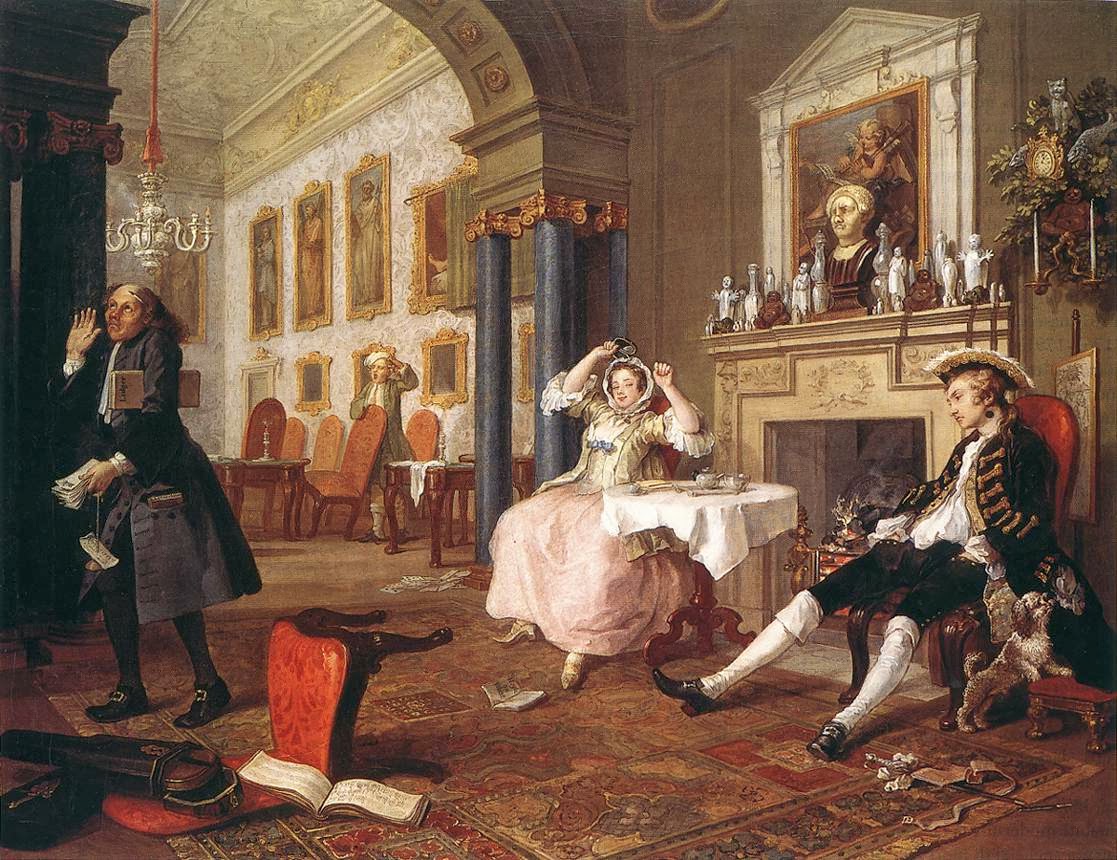
2: The Tete a Tete
This shows the troubles the arranged pair have as a married couple. The dog is pulling a woman's garment out of the blokes pocket meanwhile the wife has her legs wide open which would suggest she's been unfaithful too. The man's sword is broken suggesting he's gotten very drunk and got into a fight. The butler is looking uneasy with a pile of unpaid bills in his hand.

6: The Lady's Death, 
Fast forwarding to the end, after lots of affairs and the death of her husband by her lover, the woman kills herself because that very lover has been sentenced to death. The lady's child is leaning up to kiss her, but the fate of the child is sealed in the marks on his leg which would suggest that he is to inherit the same life as his mother (in both literal - disease, syphillis - terms and symbolic -adultery, misery- terms. In terms of style, Hogarth aimed to be inbetween the French and Dutch (the former considered too polite and the latter too vulgar).

Calais Gate, 1748
This is a bit of a dig at the absolute monarchy in force in France during this time (Louis XV). It was during his second visit to France that he was arrested for sketching this gate below. He's drawn scrawny skinny little soldiers and the only man with any meat on him is the friar - a comment on the catholicism of the country perhaps - there is a big bit of meat on it's way to the English Inn which is a reflection of the alternate name for the piece: Oh, I the Roast Beef of Old England. The name derives from an old song which represents the power and wealth of England. Furthermore, the crow at the top of the bridge represents the Jacobites -Scotsmen who fled to France after a failed rebellion in '45 - which only helps strengthen the connotations of the song the piece is named after.


The Graham Children, 1742
Hogarth was barely called in for portraits because he was a piss-taker. Some think that the fact that the boy is so amused by the scared bird means he's a sadist. I don't think so. It's just playful, as children are.

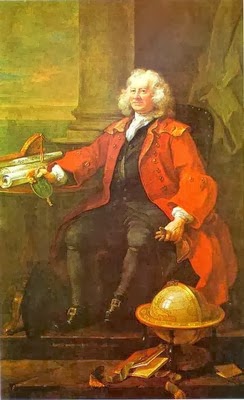
Captain Thomas Coram, 1740
Coram established the Foundling Hospital for unwanted children in 1742-45. Hogarth must have been a bit of a humanist because he has portrayed Coram in a very flattering way. He's linked him to the Grand-Style which is associated with very intelligent man. The Doric pillar behind him, the globe and pieces of a geometry set on his table is clearly making him seem like a clever bloke. Although, as said before, Hogarth wasn't too keen on the Grand Style/Tour/Taste however you want to put it. Therefore, he's given Coram the intellectual attributes of one of these men but gave him a sense of sincerity too. He's paintied Coram without his wig, and in a fairly casual pose with a sense of humanity about him. He tans like the rest of us! look at his (usually covered) forehead in comparison to the rest of his face.

Gin Lane and Beer Street Engravings 1751
Gin was, according to my lecturer, the 18th century equivalent to crack, haha. You'd have to get the worlds biggest reproduction of this image to see which engraving (they are two separate ones) is Gin Lane and which is Beer Street. Although you can't see for yourself take my word for it that the right is Gin Lane and the left is Beer Street. The idea is that Beer Street is more prosperous and in better condition because they're not all shoving crack down their neck. Notice the pawnbrokers sign is broken in Beer Street because noone needs to take out loans! Oh and, if you drink gin, you drop your kid apparently!

Joseph Wright of Derby, a Philosopher Giving that Lecture on the Orrery, in Which a Lamp is put in Place of the Sun, 1760's
This man was very succesful in the first exhibitions of the 1760's and 70's in London. Due to Enlightenment thought I imagine everyone was very excited about experiments and philosophy:
"Nature, and nature's laws lay hid in night. God said, 'Let Newton be!' and all was light"


An Experiment on a Bird in the Air Pump, 1768
Serious and modern subject, far more serious that Hogarth. Shows women engaging in conversation (flirting - or about the experiment? who knows) and a young girl looking on.  The idea that all the family could now enjoy experiments because of the enlightenment, yay.

Thomas Gainsborough, Mr and Mrs Andrews, 1750
The idea of a group portrait in England was formed in the 18th century. It has definite Rococo influences in its softness (and the Rococo chair they're sitting on!).

Giovanna Baccelli, 1782
She was a dancer and is shown as such. Light and graceful as if she was part of the scenery. There is a certain Rococo softness to this.

Mr and Mrs William Hallett, 1785
He's gone all out here and Grand-Style on us. Although influenced by Reynolds, he's done it a la Fragonard (almost identical palette to The Swing). Therefore, quite Rococo, again.


Joshua Reynolds, Mrs Siddons as the Tragic Muse, 1783
For some reason when I first saw this I must have hated it because all I have written is 'Joshuas typical pretentious shit' although looking at it now I like it a lot. The figures behind her are terror and pity. Looks like one of Michelangelo's Sybbils from the ceiling of the Sistine Chapel. I think in the last few pictures you notice Rococo sneaking it's way into English painting.
                                        

Self Portrait, 1779-80
A self portrait as 'Doctor of Civil Law', learned. He saw Hogarth as OK but nothing special because he wasn't as classical enough in his subjects. He has very modestly painted a bust of Michelangelo Buonarotti's head bowing down to him!

Captain the Honourable Augustus Keppel, 1753


Colonel Tarleton, 1782
I can't be the only one who noticed that the poses have gradually gotten more homoerotic over the years? ha check out the bend in the knee as he gets his sword out (ha) (although the top pose would also be considered 'unmanly' by today's standards).

Lady Sarah Bunbury Sacrificing to the Graces, 1765
Just another example of his 'pretentious shit' (although I do actually REALLY like the Mrs Siddons one). He had the cheek to charge twice as much as Gainsborough. It's no wonder the Pre-Raphaelites called him 'Sir Sloshua' (looky here).

Three Ladies Adorning a Term of Hymen, 1773
Hymen is the Roman god of marriage. I did not know that either and was ready to go off on a whole other tangent. But luckily not.


Venetian Rococo Painting

Rococo in Venice was similar to Rococo in France (click here). The general idea is that it is lighter, fluffier without the darkness and austerity of Baroque art. Rococo art looks as if it's been 'bathed in light' and is generally less intense.

Giambattista Tiepolo, An Allegory with Venus and Time, 1753-8

Banqueting of Cleopatra, 1740

Meeting of Anthony and Cleopatra, 1747-9

Alexander the Great and Compaspe in the Studio of Apelles, 1725-6

Rosalba Carriera, Self Portrait Holding Picture of her Sister, 1715
Carriera used pastels because she was painting on the go. It is feminine and light.

Felicita Sartori, 1728-41
The sitter, Felicita, is dressed in Turkish clothes with a mask. This was typically a mascarade costume as a Turkish hareem. The idea of perhaps flirting anonymously under a mask came to embody Venice - a city whose personification is that of Venus.

Charles Sackville, 2nd Duke of Dorset, 1730
I find portraits of men during the Rococo period were far girlier than those of the Baroque period!

Gustavus Hamilton, Viscount Boyne, 1730-1

Pietro Longhi, the Charlatan, 1757
Another allusion to Venice as a place of masks and deceit.

The Geography Lesson, 1752
Delicately taking the piss out of contemporary subjects: e.g teaching your ever so stupid lady geography.

Exhibition of a Rhino at Venice, 1751
Only in the delicate and soft Rococo would a Rhino look like a massive pug.