Showing posts with label Honore Daumier. Show all posts

Tuesday, 19 November 2013

Photography

The origins of photography are in the "camera obscura" which is latin for 'dark room'. The process uses a tiny little box which projects an image from which you can trace to produce a photo-like picture. There is evidence that the process is as old as Aristotle.

The camera obscura however, could not fix the image. That is to say, if you didn't trace the projected image, it won't 'stick'. By the 1820's a French inventor, Nicephore Niepce,  sought to fix the image and invented heliography. Heliography is a process whereby Bitumen of Judea (a light-sensitive asphalt) is applied on to a surface and then held infront of an object to 'take' a photo. The way it works is that the initially soluble Bitumen is harderned by its exposure to light and in turn becomes insoluble, you can then wipe away the Bitumen that has hardened (or not) to different degrees. You are then left with what is essentially a relief image of the main shadows and light. This process took from 8 hours to several days and one of the first photographs to be produced this way (in 1825) survives until this day:
View from the Window at Le Gras: (enhanced - very faint now)

Niepce's interest in photography lead him to meet Louis Daguerre through the optician that supplied the two with lenses for their camera obscura. Together they formed a partnership, but after Niepce's death his son took his place. Together they formed Daguerreotype photography in the 30's. The idea was the same, but with a different material held over the lense of a camera obscura. This time, they used silver made photosensitive by prior exposure to iodine.

In the 1840's the push to find an optimum way of mechanically producing an image saw to the development of the Calotype, attributed to Henry Fox Talbot but with influence from John Herschel. Talbot had produced a similar method to Daguerro at a similar time that he developed the Daguerreotype. This time though, the process was different. The image was not left to appear after hours of exposure but put infront of the camera obscura for a few minutes and then chemically developed elsewhere. The process used meant that the end image was NOT sensitive to light anymore - which was a problem in the other types seeing as if exposed to light they'd eventually just fade to nothing.

It took me about an hour to write that up just goes to show science is defo not my thing. Nonetheless, thats a really basic version of the development of photography and now that's over my brain can rest. Unsurprisingly therefore, the likes of Oscar Rejlander came to ask "is photography a science, or an art?"

For me, I see the whole photography thing as a science, mainly because reading the nitty gritty of it reminded me of a year 11 science lesson! But, Oscar Rejlander very cleverly put together a history painting-like thing together using a collection of 30 different photograph negatives. He is saying here that like photography, the academic tradition of large scale painting was very much a scientific construction too.


There is a big debate in art history over the fact of whether photographers basically forced the hand of the avant-garde's, or not. Traditional imagery could be produced in photographs so what was the point in naturalism? Furthermore, there's nothing 'special' about being able to produce a copy of an image so convincingly anymore, does this mean that the 'aura' in mimesis art has been lost forever?

Mrs Elizabeth, 1846, Calotype Print.


Traditional art began to leave centre stage, not only was it inferior in depicting truth, the rising middle classes took to photography quickly seeing as it was seen as a democratic means of portrayal. The upper classes took to it too, anybody who was anybody had to have their photograph taken, it was fashionable.

Daumier, Nadar Elevating Photography to the Height of Art, 1869. 
Nadar was the man who held the first ever impressionist exhibition in 1874, shows how photography became a flattering companion to avant-garde art and not so for traditional art.

Photojournalism was quick to emerge too:
Roger Fenton, Crimean War Photograph, 1854.

Photography also came of use to the police. A man called Alphonse Bertillon intruduced a system in France in 1883 whereby he would measure facial features of criminals to build up profiles:

"Every measurement slowly reveals the workings of a criminal. Careful observation and patience will reveal the truth"
 - Alphonse Bertillon.

The use of photography in this way was hinted at by Talbot himself way back in 1844:
"However numerous the objects - however complicated the arrangement - the camera depicts them all at once"
- The Pencil of Nature, 1844.

Another trend to emerge thanks to photography was 'Photographic Pictorialism'. This phenomena was the attempt at stopping photography becoming a tool solely for modern art. They would stage Victorian subjects, have people pose and even take photographs of dead children (ew) while in bed 'sleeping'. The idea of this was to give an 'aura' to photography. One photographer, accidentally developed soft focus, which helped the cause and gave photography a rembrandtesque chiaroscuro:
Julia Margaret Cameron, Mary Mother, 1867.


Friday, 9 August 2013

The Legacy of the French Revolution - Realism -

The first French revolution (1789) essentially abolished the feudal system that had been in place since the 8th century. The natural consequence of this is an abolition of the aristocracy along with it. in 1804 the Napoleonic code was drawn it - it forbade privileges based on birth, the freedom of religion and for government jobs to go to the most qualified. Another change the revolution brought about was the separation of state and church, a secular society promised the sovereignty of the individual and legal equality.

Under the rule of reason, there was no space for a king, which is precisely why Napoleon went and had him beheaded in 1793.

Napoleons influence reached further climes throughout Europe; an interesting consequence of this is the reason why England remains the lonely island driving on the left and using the imperial system. This is because most of the worst are right handed, aren't they? So naturally the side that the cavalry must travel on for the sake of the majority is the left - so that their right hands could draw a sword if necessary! Napoleon was left handed, he demanded the reverse, for everyone.

However, after Napoleon's defeat at the hands of Wellington and help from Prussia in 1815 at the battle of Waterloo, Louis XVIII from the house of Bourbon was anointed king in an agreement made by the allied powers. According to the members who attended the Congress of Vienna all was now peaceful. The king on the other hand was worried about the continuation of revolutionary thought and had the French Constitution drawn up.  In 1824, he died childless and his brother Charles X took power. Charles although at first was popular among the French, popular opinion quickly turned when he, alongside other things, called for compensation to be paid to those who had property confiscated during the first revolution and death penalty imposed upon those who profane the host of the catholic church.

There was yet another revolution. And another after that! In 1848 the Constitutional 'July' monarchy with Louis-Philippe I at its head was attacked for hesitating to expand the franchise - he was forced to abdicate just like his predecessor.

In the art world, what was outlined above had a big impact. The idea of freedom was hard to contain.

Liberty Leading the People, Eugene Delacroix, 1830
The personification of liberty is held against the light, symbolic of France marching towards the light. Different to Romanticism throughout most of Europe (take romanticism in Germany and England for example) as it required to be highly politicised (in some cases anyway!) Freedom is a very romantic idea in itself though.


Rue Transnonain, Honore Daumier, 1834
The elevated language of history paintings had long reigned the art genres, but it was becoming irrelevant in a revolutionary Europe. For example, the lithograph below. Would this have been worthy for a history painting? No. But it was important and massive. The face of art was changing! This particular painting depicts the consequences of a riot in April 1834 - an innocent family taken out of their beds and shot dead to make a point. Daumier wouldn't have gotten away with this for long, these pieces of art ensured that censorship was soon to return.

 
La Liberte de la Presse, 1834
My immediate thought on this was that it was sarcastic, however when I saw it I think that it may be the parliament to the left and the monarchy to the right, both arguing. If this is right, I imagine it is an allusion to them both being too busy with petty matters to notice what the press is saying about them?!
 
 
Gustave Courbet
Known as an important stepping stone for France in the development of Realism. The art of baring all to see. It developed throughout the 1850's after the 1848 revolution. Perhaps the romanticised illusion of the fight for freedom had worn off?
 
A Burial at Ornans, 1849
Dimensions of a history painting but again not a traditional scene to be depicted in these dimensions. This is also, highly politicised. He is reaching out to a different class of people, the working classes of whom have struggled to be seen as political equals. This naturally pissed off the upper classes who had always had the pleasure of history paintings to themselves. According to Courbet's friend, the only classy figure is the grave-digger leaning over the grave of the bourgeoisie! Could this signify the death of the bourgeoisie? or their dominance at least? Certainly the death of the romantics....there is nothing supernatural or idealised about this.


Stone Breakers, 1849
Depicting the lowest of the low, the people so desperate for work that they've taken to breaking stones to be used to roads! Appealing to a lower class.

 
Girls on the bank of the Seine, 1857
An example of an un-politicised Courbet. The way the girls are (one leaning on an elbow, the other looks like she's sun bathing and is getting too hot with her arms out) makes the painting lack the transcendence and allusion to another world that romanticism showed. They're just girls, lying down, nothing special about it.
 
Jean Francois Millet
Considered a realist for portraying 'the lowest of the low' but less radical than Courbet.
 
Gleaners, 1857
 
 
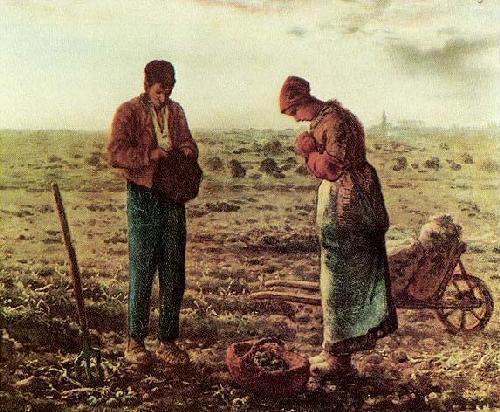
Angelus, 1857 - 59
An image of rural France where peasants know their place and look fairly comfortable; or you could say it represents pain and suffering...? either way, realist for showing things how they are.
 
A lot of emphasis has been put on the development of realism. However, this is only because of how revolutionary it was. But in reality the realists were the majority while there was a strong academy still at large. For example:
 
Battle of the Lapiths and Centaurs, Bouguereau, 1852
 
And then, of course, there was always an in-between
 The Fire, Alexandre Antigna, 1850
A normal story that can happen in a normal life but with a higher significance. The faces still look beautiful despite being faced with a face which means it is still idealised with an elevated sense of drama (drama that is probably not the genuine way someone would react but dramatized nonetheless!
There is palatable realism here but still abiding to some of the tradition.


 Voila