Impressionism was outside the academy, of course and whose subjects revolved around modern middle class life and landscape 'en plein air'. By academic standards, it was not 'finished', but to the impressionists they were painting the impression that something gave off rather than the view itself.
Origins:
Courbet (some of his artwork written about here).
He was one of the heroes of the impressionists because he introduced modern life as a subject: going against academy with his contemporary subjects.

The Barbizon School was also influential on the impressionists. It was a school of painters who were involved in the realist movement. They themselves were influenced by the romantic painters Constable and Turner (in landscape painting). They are written about here.
Some examples of painters from the school:
Camille Corot, the Bridge at Narni, 1826.

Theodore Rousseau, A Tree in the Fontainebleau Forest, 1840.

Another idea that the impressionists called upon was that by the colour theorist Michel Eugene Cheureul. He wrote about colour in his book: The Principle of Harmony and Contrast of Colours, 1839.
- He discussed the relationship between primary colours (yellow blue and red) and the complementary colours (orange green and purple). He believed that used together they play off of eachother and create a brighter and more intense experience for the viewer.
Furthermore, another fact that was extremely important in the development of art en plein air was industrialisation. Paint brushes and paints began to be produced comercially. The paint in tubes that were produced had already mixed the medium with the pigment. Without this, it would have been inconveivable to pop your easel anywhere outside and easily prepare the paint.
- Subjective impression on the view, the vision of the individual.
- More towards abstraction: not a depiction of reality, a different world.
- For centuries art had to be naturalistic, tell a story and educate (specifically from the academic point of view), but impressionists turned that on its head.
- The way art is represented becomes more important than what is represented itself - because own representation (colour,shapes,form) reflects your own impression and feelings.
- Becomes its own language, broken relationship with imitating nature. The more abstract a painting the more artistic it is, because art is its own language.
~ The 1860's are considered the formation years of impressionism, the 1870's the hay-day of the impressionists, and the 1880's was the decade of crisis for the impressionists ~
A big phenomenon in the impressionist era was the 'Societe Anonyme des Artistes'. It was an exhibition for impressionists and a reaction against the French academy run Salon. A handful of exhibitions were held from 1874 onwards but it was only Renoir that remained until the end as the others started to veer off and do their own thing! The media were not sympathetic towards it.
Impressionism:
Claude Monet, Women in the Garden, 1866.
Painted in the 60's, the development decade for the impressionists. Still has resonance of the realism movement.

The Road Bridge at Argenteuil, 1874.
Exhibited at the Societe Anonyme des Artistes during 'the great decade' for impressionism. Monet was experimenting with the different impressions that can be made by seasons and lighting.

Red Poppies at Argenteuil, 1873.
Exhibited at the Societe Anonyme des Artistes during 'the great decade' for impressionism.

Autumn effect at Argenteuil, 1873.
Exhibited at the Societe Anonyme des Artistes during 'the great decade' for impressionism.
.jpg)
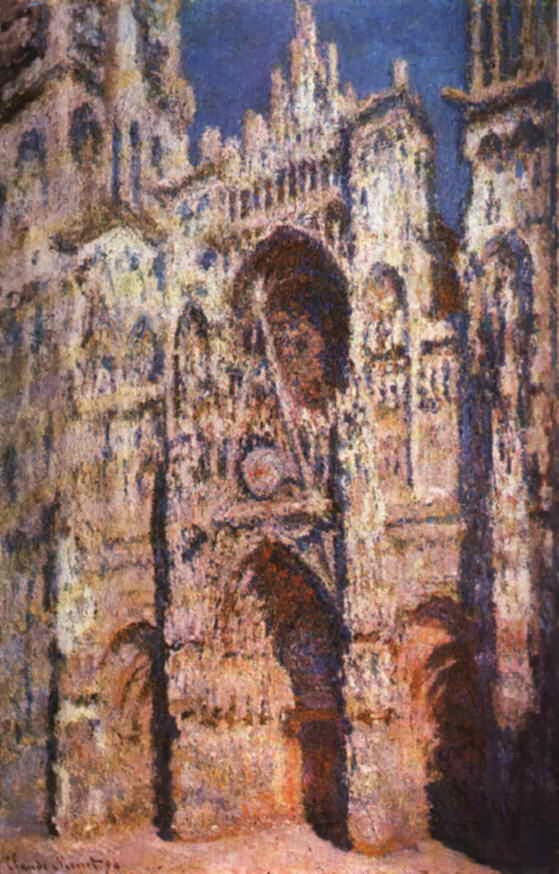
Rouen Cathedral, 1892-94.
This was painted alla prima which became widespread in the 19th century (only Titian in the 16th century).
This was one of many reproductions of this image - Monet lived outside of the cathedral and spent hours upon hours depicting this place at different hours of the day and in different seasons of the year. Looks like they're done quickly but they actually took a very long time. He'd paint one at 10 minute intervals at different times of day and then return to it the next day. Monet was not one of the artists who returned to a fixed pictorial space, he carried on the route of abstraction.
Haystacks, 1890-1.
He also did a lot of these too. He had an obsession with the impression that light gave to an object.

Les Nympheas, (water lillies), 1914-26.
These were a series of 250 or so paintings during the last 30 years of his life. He was suffering with Cataract disease at this time and had an obsession, of many, with his flower garden at Giverny.

Pierre-Auguste Renoir (1841-1919)
La Loge, 1874.
I suppose this one is quite famous firsly because it's Renoir, but secondly because we see the female here supposedly looking away from the show. She is uninterested. It calls upon Manet's Bar at the Folies Bergere whereby the woman has an unmistakably dead-pan look.

La Premiere Sortie, 1876/7.
This shows impressionism at it's height of success before the 1880's decline. Being called the first exit or the first outing we can only assume the young girl is being accompanied to her first ever outing at the opera.
.jpg)
Le Moulin de la Galette, 1876
With Renoir, although images became increasingly blurry, they seem far more real or reflective than the academy. We see things in movement, never still. He left visible brushtrokes and contrasted bright, pure colour a la Michel Eugene Cheureul. ,

The Umbrellas, 1881-86.
This is one of my favourites, particularly because my niece was asking me about my degree a few months ago and when I said I was writing about artists she told me she wants to see this (below, National Gallery) that she'd seen on Nick Jr. Unfortunately when we went it was on loan to somewhere in Ireland! It shows how the brushtroke became increasingly solid towards the end of the impressionistic era.

Luncheon of the Boating Party, 1881.
A famous cafe on the river of the Seine outside Paris, a little more traditional than previously, as impressionism began to disintegrate.

One of the men here, Gustave Caillebotte (on the bottom right with straw hat) was an artist himself. He always stayed faithful to naturalism unlike the impressionists but uses impressionistic features. It was perhaps borderling impressionism. He was a collector of impressionist art. A piece of his: Rainy Day 1877, shows the innovative street design under Napoleon III whereby he constructed the boulevard's very wide so that barricades could be put up easily in case of rebellion.

Degas (1834-1917)
Degas depicted slightly more traditional scenes but constructed them in a revolutionary way. He is known for being obsessed with dancers and offering a 'snap shot' of a larger vision.
The Orchestra at the Paris Opera, 1868.
As I said earlier, this is like a segment/close-up view. There's an influence of photography too (that was created in the 1840's).

L'absinthe, 1876.
The bright pastel like colours that are found in this period are also attributed to the mass arrival of Japanese prints from 1854 onwards (after american intervention to get Japan to re-alight trade links between themselves and Europe). This depicts the French bohemian world - an actress next to an artist. We are sitting from Degas' point of view and can see his signature on the table. The pair drinking alcohol must have implied that the two may get together later on because this was exhibited in Victorian London and did not go down well at all.

The Dance Class, 1871-74.
As I said, he was famous for his ballerinas. It's casual, depicting what he observes.
.jpg)
The Star, 1878.

Miss La La at the Cirque Fernando, 1879.
This is painted as if we're in the audience. Degas stayed faithful to his own take on impressionism but did become increasingly colourful.
.jpg)
Dancers at the Bar, 1900.
Here you can see the diminishing of the renaissance, cannonical ideas. The beginnings of abstraction. When values in a society or culture change, the visual arts do too - art is a reflection of culture - and uptight traditional culture was taking a step back.