Wednesday, 21 August 2013

Édouard Manet

To try and put it in simple terms for my head to understand, what I've already covered on here so far is the movement of Romanticism (Germany, England and France) and how it came about - then the Realist movement and how that manifested (namely in France). Manet as a realist himself (like Courbet, Daumier, Millet...) is now the man who bridges the gap between realism and what was to come next: Impressionism. This is what I will hope to make sense of in this post. Important to note that Manet did not form part of the movement itself, nor was he an impressionist but he 'fathered' it somewhat. He was about 10 years older than all the youngens who began the impressionist movement, he was there, and began to be influenced by them.

My coursework due date is drawing to a close and I only have a few weeks of lectures left until the end of term and hence the end of this course. For the sake of making use of this to study with when I have my exams in Dec all posts from this course have been tagged as Romanticism - fin de siècle 1800-1900. I'm doing two courses at the moment so all the other posts under Baroque to Neoclassical are separate from this :) There is a method to my madness.

Anyway, Manet. As a true realist he was labelled a 'Flaneur'. Apparently this means stroller, as in he strolls about observing the nature of normal and real life. He was born in 1832 and died in 1883 at the young age of 51. His dad was adamant that he would join the navy but after failing both of his assessments in 1848 his dad gave in to his desire to be an artist. Like any aspiring painter of the 19th century the done thing was to be trained under a teacher in one of the numerous academies that were about. Academies and their work were solely interested in the maintenance of the Albertian found principles from the 1420's. His teacher was Thomas Couture who was very prim and proper. Although, while Manet went about his travels in the Netherlands, Italy and Germany he began to draw influence from Hals and Velazquez (from the Baroque period) and a fairly contemporary figure: Goya (a Spanish romantic). The paintings below are from the period 1856 onwards when he set up his very own studio.

The Absinthe Drinker 1858-1859
Shows a low-life having a drink. Apparently from Bohemia... He may very well be dressed in a top hat and striking a posh pose but I get the overwhelming feeling that it's a bit of a piss take. What I notice is that there is a shadow cast over his eyes, maybe he can't see out of the hat properly - that would mean him and his mates have stolen it off of some poor old sod and posing about in it. Besides, a prim and proper bloke wouldn't leave his glass bottle on the floor? and surely wouldn't be in front what appears to be a random bit of broken wall in the back alleys of Paris somewhere. Not a heroic/historical/academic subject at all, just real people.

I don't really know much about Absinthe, only that it is lethal and should never go anywhere near my mouth - but was it the same then? Would make the painting better if it was.


La Dejeuner sur l'Herbe 1863
A group of Bohemians or students. The naked lady is barely the Venis Pudica of which there are THOUSANDS of examples. She has no shame, her face is plain - she has a doesn't care 'what are you looking at' kind of attitude. This was quite a scandal because while painters could paint the most porn-like women as long as they were mythological or some other kind of subject with academic standard acceptance, to paint a woman naked for NO reason was madness.
 
Manet adapted a palette of bright tones and dark tones - without a middle tone. The park is dark, the figures are very bright. Something that is usually credited to Velazquez's influence. Of course other influences cannot be denied, only 6 years earlier Courbet's Demoiselles des bords de la Seine (can be found here) caused similar outrage when he depicted young girls doing, well, nothing. A young lady chilling on a river bank = MUST be a prostitute or something surely? especially with that corset without an over-layer.


Olympia 1863
If the painting above caused a disturbance then this one caused a full-scale riot. She was not the cute 'nude' of the past that was specifically differentiated from naked: Nude was an elegant, modest show of everything. Naked is just a shameful naked. Olympia was obviously branded as 'naked'. The thing that pissed off everyone the most is that this actually made its way to the Salon (early version of an exhibition, had to be approved by a panel of academics!!!). It is believed that a few of these kind of heathen paintings got through the cracks because the academy were trying to be hip and gain popularity over the ever increasing in popularity anti-salon = the academy for the rejected art!
 
So this meant, Olympia came eye to eye with the Bourgeoisie - couples would visit what they think was a respectable art showing and see this 'atrocity'. What's more, the men had probably had sex with a prostitute as ALL of them were at it and considering the fact that the viewer is made to feel like the client because of her stare......well......it may have produced a few guilty faces among the posh fellows and maybe a few domestics as a consequence.
 
 
The Venus of Urbino, 1535 was fine to be naked. It is Venus after all. A dog is at her feet to suggest fidelity as dogs are loyal in nature - now look back up at Olympia in the same space ....bet you didn't see the cat before? Manet is obviously making a point with an independent animal like a cat. Olympia is the modern day Beyoncé. Another view (one that creeps me out a bit) is that seeing as French people (back in the day too) endearingly referred to a certain part of a woman's body as 'La Chat' then.... A caricature artist obviously warmed to this view (Look below Venus!)


Dead Toreador 1864-65
As a realist Manet's dead people were not honourable or heroic! This man has just been killed by a bull, and he's dead. This is what a dead man looks like. There's no need for angels hanging about holding a cross to refer to the resurrection or for his face to be placid! Realism.


Portrait of Emile Zola 1868
This is in essence a pictorial manifesto if you like. A painting to show the beliefs of this individual. Think a painting of David Cameron with everything painted in blue and a picture of an unoccupied bedroom on his wall and the new school curriculum in his hand. Emile Zola was very well known to be a good friend of Manet. A writer, he would often praise and defend Manet in the wake of his critics. Notice on his wall? There's Olympia.
 
 
The Execution of Maximillian 1868-9
In 1867, an Austrian called Maximillian was sent to Mexico as a 'puppet' emperor. His safety was guaranteed by the imposing force of the French who sent him there. When the French withdrew he was captured, and executed alongside two of his generals. There has been drawings of this found, where the soldiers wore typical Mexican dress; Manet changed his mind and was obviously trying to make a point, he changed their uniforms in the final (this) version to French uniform. He blames the French (he was considered a socialist somewhat so it isn't surprising. There are actual PHOTOGRAPHS of this event, took me by surprise!!!! Been studying this since September last year and this is literally the first painting I've been shown a photographic equivalent to!
 
 
As I said, he was a fan of Goya. This is Goya, Tres de Mayo 1808, 1814. I'm so sure I've spoken about this before but I can't find it to link to it how annoying! Anyway, Manet was drawing influences from Romantics and their method of painting, but put his own realist twist on it. Here Goya still has the Spanish man holding his hands out in a very Christ-like fashion whereas Maximillian has jolted backwards from the force of the gunfire.


The Barricade & Civil War 1871 (lithograph)
As I touched upon earlier, Manet was somewhat of a socialist. He didn't completely sympathise with the communards but was not happy with the suppression found with the French government.
His lithographs of the era show the brutality of the war. The thing is though, these images do not invoke much emotion, it all feels a bit pointless. I reckon this is the very feeling Manet endeavoured to convey.
 
Also, it may be a bit hard to compare because this is not a painting, but imagine if it were, the brushwork would be looser would it not? obviously lithographs did not allow the same accuracy as painting on a canvas BUT as a skilled man he would have been able to give these two a finer finish if he'd wanted to.
 
The Franco-Prussian war saw to the fall of the 'second empire' in France. As German unification gathered pace in 1870 they thought it was necessary to begin a war with France in order to be able to unify the northern confederation of Germany with the independent German states of the south. Napoleon III felt these tensions building and got wind of the Ems Telegram which he interpreted as a threat and declared war. French politicians were confident they would defeat Prussia. Unfortunately they did not. During this war, which caused the ever emerging politically conscious lower classes to live in poverty and suffer, a movement called the commune (communards) rallied against the new government. The government took this threat so seriously that they sent back for more armaments, unfortunately for them the military eventually sided with the commune. The events that were to unfold lead to the death of 18000 Parisians and the imprisonment of 25000 in the civil war, when it became the most violent in what is known as the Bloody Week in May 1871. The commune lasted from March-May that year and the aftermath was about 4000 communards being deported to New Caledonia once the government came to take revenge.


The Railway 1873
Compare this to the earlier paintings, the dissolution of the painterly surface is on its way although we can still see the composition is still largely 'finished' close to academic terms (unless you look very close then the brushwork is free). Notice she's the same model as Olympia, Victorine (I think). Daring of him to show a modern landscape with a train and the smoke emerging from its engines. The look on her face is the same as it always is, dead-pan.  
 
 
Rue Mosnier Decked with Flags and with Road Menders 1878
Random man walking about, building work... All very akin to realism and the values of the movement. BUT his technique is becoming more free, just as Turner's became too. He was being influenced by his young friends, the impressionists.


A Bar at the Folies-Bergere 1882
Maybe one of Manet's most famous paintings, and my personal favourite. Classic dead-pan look. A barmaid, bored. Her reflection is odd, it looks like someone else (to the right). You can see she is chatting a man, we think he's a pervert, and we're made to be the customer (AGAIN). She's doing her thing, maybe she was a prostitute too, on sale like all the commodities around her. But while her reflection looks as if she's close to this man, engaging in conversation, our view of her conveys a sense of 'I'm sick of this' or 'I hate doing this, but it's what I've got to do' about it. The subject of course is very realistic, a woman working in a nightclub in paris. The food and drink painted in an elegant still-life manner. There's a show in the background, just all very mundane and normal.
 
 
Las Meninas 1656, Velazquez
I did mention he was a fan of Velazquex, and perhaps he took the mirror-image thing from this one here. Again i'm so sure I've spoken about this before but I can't find it, but basically we are the subject, the painter is painting us. But in the mirror right at the back the King and Queen of Spain are stood there.


Eva Gonzalez
The only formal pupil of Manet
 
A Box at the Italian Theatre 1874
The dead-pan look remind you of anyone?
 
 
Manet, Boating 1874
The relationship between the two figures (although inverted) are similar too.


:)


Monday, 19 August 2013

Holiday blues

It has basically been 2 months since I departed for sunnier climes. Of course, July & August is when the whole world and his brother go away so naturally I've been left with a bucket load of nostalgia; and because my university timetable is an absolute pain in the arse August get aways are a no-no. Boo.

Time to post a holiday remembrance post, r.i.p xxxxxxx

I went to Gran Canaria with my boyfriend, had an amazing time, got a little bit tanned, got fat and because Ross is just as much of a geek as me we had fun visiting museums and churches, YAY.

View from the balcony! Behind the hotel isn't as pretty as in front of it...

La rotonda en el paseo maritimo; PLAYA DEL INGLES

Ross & I clearly do not have an skilful eye for symmetry, Hard work though!!


Red. Raw. Shoulders.


Brazil vs. Spain 30th June - Nail patriotism, Españaaaaa ! (even if they did lose)


El Ayuntamiento de las Palmas de Gran Canaria.

Eeeep :)
 
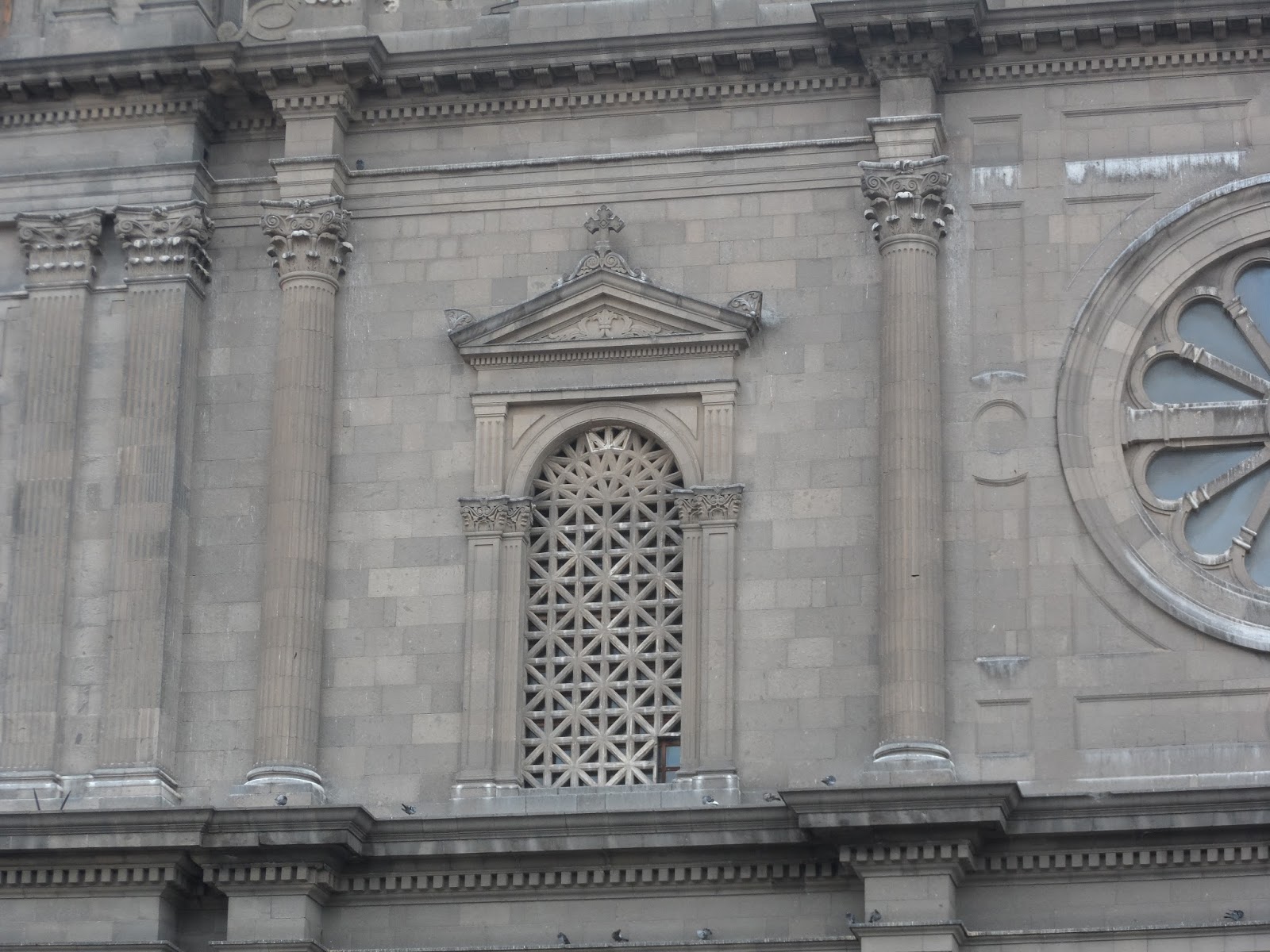
Catedral de Santa Ana, 16th century Baroque. Much like churches and cathedrals you'd find on the west coast of America (from when the Spanish controlled CA etc!)
 
It is in the Vegueta district of Las Palmas, the capital of both Gran Canaria and the Canary Islands as a whole. The Vegueta district is known as the old town of Las Palmas. Full of historical things and just opposite on the other side of the main road is the Triana district - famous for its shopping strip !
 
Work began in the 16th century, but it took right up until the 1900's to complete. This is the reason for a lot of contrasting elements.
 
It's got a hint of Renaissance architecture in there with the triumphal arch - like entryways, a Little bit of Gothic in the Rosette window... but in general, it is Spanish Baroque. Just like Baroque in France and Italy there is an effort to connect the tiers of the building with columns which is perhaps the most obvious of the Baroque elements.

You can see here the engaged columns (a column in the round but engaged -touching- the surface of the Wall) and the Pilasters (flat-packed columns stuck on the Wall) placed next to eachother. It gives the sense that the building is stretching out sideways because the columns are getting more 3D and further apart the closer to the perimeter of the wall that they get. Fluid movement in architecture: Baroque.


Ionic column with girnormous abacus', it isn't supporting the entablature either but just the protruding área instead. Random & playful take on classicism.

French Gothic inspired Rosette window.

Ross with Gran Canarias namesake - the Gran Canines. Several of these plotted outside the cathedral.

 
Pretty Little cupola

 
We didn't take the lift, opted for the stairs. Turns out the route to the Campanario (bell tower) in old cathdrals are not so well lit. It was SCARY. But we got right to the top :)


Composite capital

 
All the buildings dotted around the Vegueta and Triana district look similar to this - apparently the área was largely built in the 17th century. I'm a bit confused on this one I'm not entirely sure what kind of style it is - but from what i've seen it looks like a mix between the Florentine Palazzo and Inigo Jones' Banqueting house (especially the Windows). An assortment of influences I imagine, just like the cathedral. Besides, it's looking way too white to be in its original state so I'm going to place my bets on the fact that it may have been altered a little bit at least. 


A homage to the Canarian bishops that had their ministry in America
 
Las Palmas de Gran Canaria, Monday, 12th October of 1992, 500 year anniversary for the discovery and evangelisation of America.


It's a shame I can't remember what this was about, or read the inscription at the bottom its too unclear! But I can only imagine it is King Fernando II de Aragon. If Las Palmas is particularly proud of the evangelisation of America this is bound to reference him. He, alongside his wife Isabella I de Castilla of whom he married to successfully marry their two kingdoms, 'finished off' La Reconquista. The Spanish Kingdoms had long been pushing their Catholicism downwards into the occupied Moorish territories but it was not complete until the royal couple took the last stronghold standing - GRANADA. Incidentally at the same time (1492) Christopher took his voyage to the Americas. Obviously, he didn't appear and America miraculously became Christian, but I suppose it's a fairly symbolic date.
 
Anyway, what makes me think that is that the statue is holding a ball, perhaps an allusion to the globe. This possible globe has a Latin Cross stuck in it as if he'd just climbed mount Everest and pierced his countries flag through the ground. Evangelisation of both sides of the Atlantic...the world? boom!
 

The pulpit

The inside, very decorative vaulting, half of the ribs aren't necessary - just for show.


18th century painting of the man who made all of this happen - the architect.


One of the side views of the cathedral.


Next we visited Christopher Columbus' place of residence in his stay there before he went off to discover America. This is in the same district as the Cathedral and has a library for students and a museum.


This was made shortly after Columbus' trip - before aerial photography it is BEYOND me how they were so impressively accurate! It's a bit of a weird perspective, (a bit like the map that is made with Australia in central position, has anyone else seen that?! Didn't realise it was a map of earth until I was 15 and I'd been doing Geography in the same room since I was about 12!). Anyway, I'm no expert on maps and that but what I do know is that the little isolated island to the right of the Meridian line looks A LOT like where I live. Wouldn't doubt Spain, France and Italy either!!

How weird!!

 
If my memory serves me correctly this is a part of the Catalan Atlas. 

 
This Atlas was done at a similar time as many others that were on display in museo Casa de Colon; all early 16th century. This is even more impressive than the last!


"This is the island of Saint Borondon, - The siren island - according to the ancients that saw it. If the illusion of this famous imaginary island had manifested throughout different ages in different forms, then in this version - probably from the 17th century - you can see Saint Borondon or Saint Brandano, the namesake of the fabulous island, saying mass on it, which takes the form of a whale, observing the location of the Canaries."

Right, so. I'm fairly confident that my translation is correct BUT that doesn't mean it's massively clear. It's taking about Canarian Folklore that tells us that since the 6th century AD, people have sworn to have seen this imaginary island floating about. They say it's hidden by clouds and disappears and reappears. A bit bonkers really, I'm sure if I had the entire series of wall stories from the museum this would make more sense! You've got the bloke it's named after aboard the island that's the shape of a whale (why, I don't know) doing mass (is that the verb for it? meh). The last sentence is a bit nonsensical to me too - but the gist is there.

There was loads of these little stories written on the wall of the courtyard of the Casa de Colon with illustrations to accompany them. I would have taken pictures of all of them except my boyfriend was bugging me to nick my camera to get about a billion photos of these two below:


Another roundabout, but in Las Palmas this time, outside the shopping centre.

Loads of handprints of 'famous' people of whom we did not know.


JUEGO DE TRONOS - game of thrones - in Spanish! Life = complete.
 
Waking up on the last day as very unhappy bunnies :( We had a 'blanket trip' booked for the day. This is where you get a man trying to tell you blankets and other random things with a free trip to cave houses and a cute village in return. The meeting was not time-share-like, it was easy peasy to avoid buying something, plus there was a raffle going, and the people were really nice! So it is really worth doing.

 
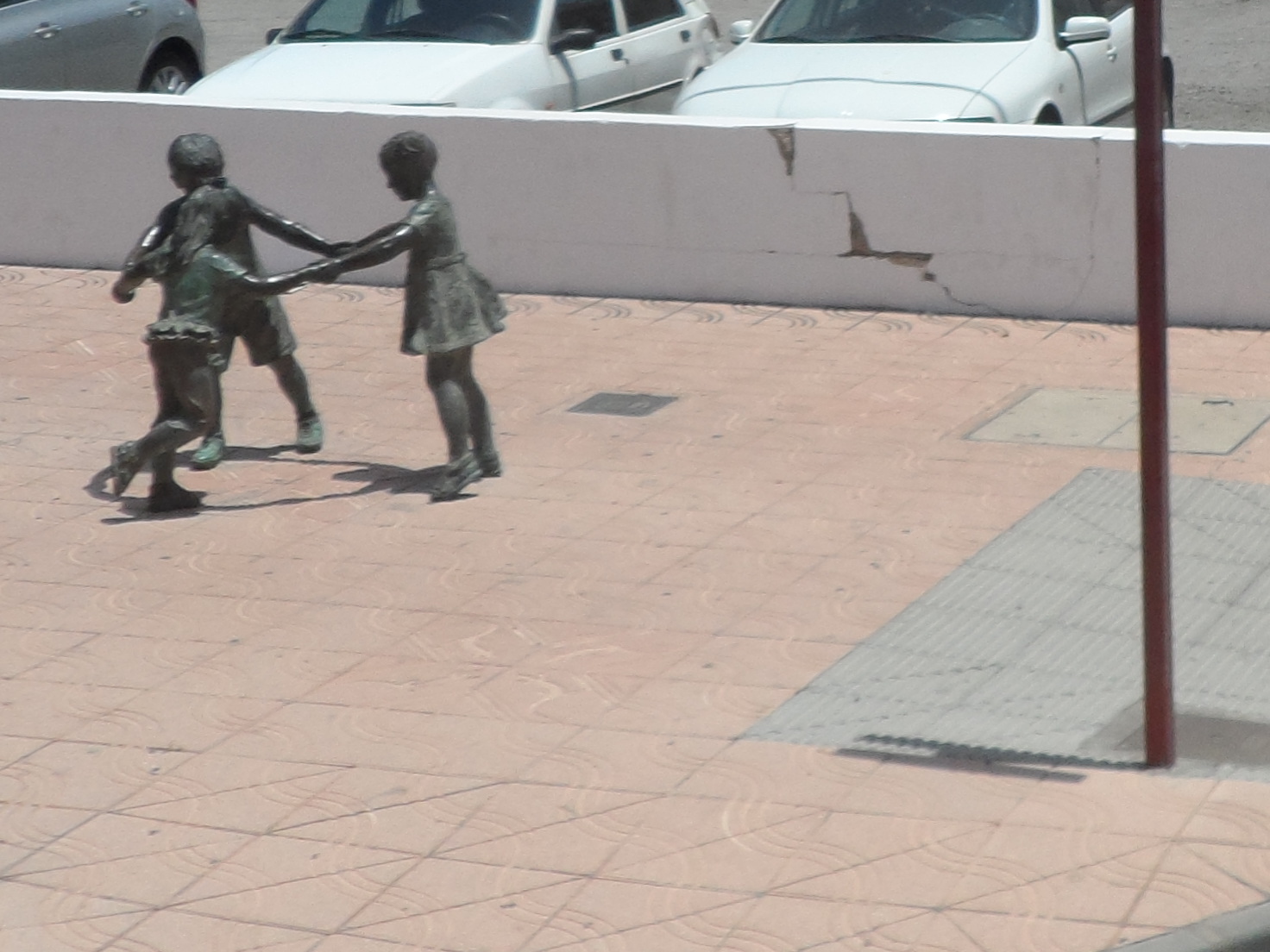
Apparently this street (completely lost the name!) is fairly renowned for all its random statues of children playing - I thought this one was cute! There's others, kids playing conkers, riding a bike.... etc.

 
Our final day was spent here: Guayadeque. The village of CAVE houses! This was there restaurant: £6 eurors for a mixed Tapas. Wasn't a great fan but the water went down extremely well high up in the mountains of a calima-ing Gran Canaria.

 
Yeah, I really don't know. A you know what in a you know where? a woman upside down doing yoga? Either way we were simply told it is a 'fertility statue'.

 
The inside of their little cave church! creepy.


Good old Greek Cross - bizarre in Spain, but then again a church in a cave is also bizarre.

 
confessions.


The most house proud lady of all of the cave community.

 
Congratulations Isabel C.M. for being the best mum in the world, your daughter Chani loves you. Aw :)

 
THEY LIVE IN CAVES!!!!! This is what we saw as we entered, this little room, I imagine there's more behind that door.

Entrance to another crib

The bedroom!

 
Real Madrid fan - probably the ONLY time Canarians will consider themselves Spanish - Football - otherwise they insist that they are Canarian.


The people were literally the sweetest people I've ever met, so talkative! They get so haps when you tell them their cave house is nice.

 
Aguimes, a quick stop on the way back from the cave houses.
Who knows whether tour guides chat shit but two good things she told us about this place is 1) that there is a curfew for young girls under the age of 18 (or something like that) unless accompanied by an adult.
2) people who move out here leave their dogs on their roofs! If you ever buy a house here, check they haven't left their dogs....

Saint Sebastian with all his arrows.

Their local church - gutted it wasn't open. Similar to Santa Ana, just a little more plain.


The Plaza was covered in life size statues such as these. There was a congregation of poets on a bench and some other ones but this was my favourite. Legend has it that while under Franco's rule men and women of Aguimes would cross-dress and wear masks and partaaaaaay. This is significant because Franco banned fiestas, this obviously wasn't stopping the people of Aguimes - they just had to disguise themselves a bit.

Old Aguimes, noble Aguimes
Keep on dreaming your dream,
For an angel is watching over you,
And the wind is rocking you.
 
Part of a poem on a small wall in the Plaza, cute!!

 
We got to try out the Thomson Dreamliner on our way back, was too excited about this. Screens in the back of the chair in a short haul flight?! life
 
Have you been on holiday recently? Has anyone been here?
xxx