Tuesday, 19 August 2014

Florence 2012 Journal: Analysis of the fresco cycle in the Capella Maggiore at Santa Maria Novella

Analysis of the fresco cycle in the Capella Maggiore at Santa Maria Novella

The Capella Maggiore of Santa Maria Novella is called the Tornabuoni Chapel. It is renowned for its fresco cycle depicting the life of the Virgin Mary on the left hand side of the wall and the life of St. John the Baptist to the right hand side. The fresco was painted by Domenico Ghirlandaio and his workshop in the late 15th century.

There are 9 scenes from the life of the Virgin. The scenes read left to right, bottom to top whist the 5th scene is situated in the middle row of the central wall towards the left. The second from last scene is painted in the lunette at the top whilst the last scene is in the lunette of the central wall. The scenes begin at the expulsion of Joachim from the temple. The remaining 8 scenes tell the stories of the following: Mary’s Nativity, Presentation of Mary at the Temple, Marriage of the Virgin, Annunciation, Nativity of Christ, Slaughter of the Innocents, Assumption of the Virgin and lastly, the Coronation of the Virgin.

Facing opposite, the life of St. John the Baptist reads in the same way and similarly has the 5th scene painted in the middle row of the right hand side of the central wall whilst the 8th scene is painted in a lunette. The scenes are: The Apparition of the Angel to Zechariah, Visitation, Birth of St. John, Zechariah Writing His Son’s Name, St. John in the Desert, St. John preaching, Baptism of Jesus Christ and Herod’s banquet.
The central wall is mainly covered by the stained glass windows. However as already discussed, the lunette at the top depicts the coronation of the virgin and the middle row of either side tells a scene from the lives of the two saints. The remaining 4 scenes are St. Dominic Tests Books in the Fire, The Martyrdom of St. Peter, Giovanni Tornabuoni (the son of Domenic) and lastly his wife, Francesca Pitti.[1]

There is an abundance of painted bronze, expensive jewellery and extensive decoration painted throughout the fresco cycle. Much of the bronze decorations and decorations on the pilasters (the ones found in the scene of Mary’s birth) are believed to be copies from pictures in the workshop books from Tornabuoni’s workshop. The copies were carried out by the less experienced in his workshop, in order for them to practice. The art historian Carol Frick also notes that the expensive jewellery painted in the fresco cycle were family air looms of the patrons and served as an example of their wealth[2]. This ties in with the assertions made by Jill Burke, who stated that, the patrons of whom were awarded rights over the chapel where done so if they were to provide ‘honourable decoration for the space’. Although this would refer mainly to the ‘ornament, books and other expenses’[3] it is also clearly a reference to the depictions of valuable ornaments and jewellery in the fresco cycle itself.

Although one would assume that the main purpose of this chapel is wholly religious, Florence was very conscious of the fact that is was ‘renowned for power and wealth, for its victories, for its arts and its buildings’ and ‘enjoyed great prosperity’[4]. Conclusively, this chapel like many others exemplify the power of the city and the patrons of the church and it is feasible to assume that the churches themselves were where the Florentines boasted their wealth the most.


[1] D. O’Leary, Harmony and Ritualistic Allusion in the Tornabuoni Chapel in Santa Maria Novella, (University of Michigan, 1983)
[2] G. Brucker, Florence: the Golden Age 1138-1737 (University of California Press, 1998), 55.    
[3] C. Frick the, Dressing Renaissance Florence: Families, Fortunes, and Fine Clothing (John Hopkins University Press, 2005), 271.
[4] J. Burke, Changing Patrons: Social Identity and the Visual Arts in Renaissance Florence, (Pensylvannia State University Press, 2004), 123.

Florence 2012 Journal: Santa Maria Novella

Santa Maria Novella

Santa Maria Novella was built as the city’s most important Dominican church and is largely Gothic in style. The facade was completed by Leon Battista Alberti in 1470 and was paid for by some of the most affluent families of Florence at the time. The name translates to the ‘new’ St. Mary; this is because the Dominican order who took hold of the church in the 13th century wanted to build over the earlier 9th century oratory, Santa Maria delle Vigne.


The layout of the church is a Dominican tau shaped cross. As with Santa Croce, there are 16th century altars that were an addition from Vasari, although they are far less imposing than those at Santa Croce. An example of this is the fact that Vasari deliberately avoided covering an earlier fresco on the wall. Instead, he built an altar structure around the painting (this has now been removed and only the fresco remains).


The fresco (above) was by Masaccio and depicts the holy trinity (1425). There are evident influences from Brunelleschi here in the depiction of coffers. As we know, Brunelleschi had studied the pantheon in order to build the dome (started in 1420 and completed in 1436) in Santa Maria del Fiore.
There are also notable features that suggest an influence from the Northern Renaissance. Firstly, the kneeling figures is something thought to be derived for a Dutch school but more importantly from the Netherlands came the idea of playing with death. At the bottom of the image, there is a skeleton, (a Memento Mori (reminder of death)) with an inscription that translates ‘I was that what you are and you will be that what I am now’.

A similar example of a painting that warns us that we will be ‘how they are’ is an early 16th century painting by Giorgione, with an elderly, toothless woman pointing inwards to herself. This was based on a poem by the late Lorenzo the Great (died 1492) about a young beautiful girl and the race to get married before she was too old.

Returning to the painting by Masaccio, there are four spectators in the scene. Two remain outside, likely to be the commissioners, and the two people either side of Christ are Mary and St John the Evangelist. Mary is seemingly detached from Christ’s death as she shows no sorrow and points us towards her son on the cross. This is usually interpreted to mean that Mary is already aware of the fact that he will resurrect and is therefore not upset. 

This painting is largely in one point perspective. Note how the people in front of Christ are not bigger, and that everything behind him gives a sense that they are receding. However, there is one exception: God the father. He is too large; by the rules of one point perspective he should be receding into the background as are the people in the foreground in order to make Christ the centre of attention. This bending of the rules is testament to how important God the father was – he must always be represented as the most important.

Another important piece of art that the church has is Giotto’s crucifix that has just been restored. The crucifix bears the innovative depiction of Christ’s belly (usually painted in three unnatural sections in the byzantine manner. See Right), that portrays the genuine effects of crucifixion on the belly. When someone is crucified, the lower abdomen appears hollow because the stomach rises up higher in the body and crushes the lungs.


Giotto’s crucifix (above) is on top of a rock formation at the bottom. Christ is painted as bleeding from his Stigmata; the blood is shown to be covering the rock underneath. If looked at closely, the very bottom of the rock has a slight niche where you can see a tiny skull. This represents Adam from the story of Genesis and follows the legend that Christ was killed on top of Adam’s burial ground in Golgotha and that Christ is dying to repent the sins that are seminally present in everyone because of the fall of Adam and Eve.

As mentioned earlier, rich families helped fund the build of the church and therefore have their own respective chapels. One of the families who helped fund the church was the Strozzi. Their chapel is to the left of the Capella Maggiore and it is decorated with frescoes with an altar piece in the middle. The subject matter of the chapel is the Last Judgement. The right wall depicts paradise, the middle wall purgatory whilst the last wall is a depiction of hell. There are a number of inscriptions that are derived from Dante’s Divine Comedy. The frescoes were completed by Andrea and Nardo di Cione and Niccolo Di Tommaso in 1360. The altar piece is slightly regressive in sophistication for its time because tt was made shortly after the Black Death. Therefore a handful of artists who knew the new techniques were gone whilst the ones who remained believed that the Black Death was caused by the less holy depictions of saints in art work. Finally, as with many altarpieces, this needs to remain in the chapel for the iconography to make sense. For example, the Predella of the altar piece where the devil and angels fight for the souls of the dead would not make contextual sense if sat in a museum.

Florence 2012 Journal: Florence and the Renaissance

Florence and the Renaissance

Throughout the Renaissance there was a large sense of civic pride in Florence; not surprising considering that from the early Renaissance right through to the 16th century the biggest names of the era came from the Tuscan city itself. Here I will discuss two of the most notable perspective techniques that marked the beginnings of the Renaissance that were introduced by the Florentine Donatello (1386 – 1466) and Lorenzo Ghiberti (1378 – 1455).

From very early on in the early Renaissance, the Florentine Donatello was already keeping perspective. The sophistication wasn’t quite of the same level of what came nearly 200 years later however; he did use linear perspective. Linear perspective is where the size and position of objects or figures are relative in that they will recede into the background as the lines of perspective draw in closer together running diagonally and meet at the ‘horizon’ of the painting.
For example, Donatello’s relief of the Feast of Herrod clearly shows linear perspective. However, this is a relief that also uses the technique of Pictorial perspective alongside the linear perspective. This means, while the relief shows the arches and figures getting progressively smaller the further away they are, they also get flatter. You would notice that the foreground of the relief, if you were to touch it, would protrude more than right at the background, where it is almost completely flat. This creates an illusion of space and the term used for a flattened (or smashed) relief is ‘Schiacciato’.


Another technique that was an innovation for the Florentines of the Renaissance was one point perspective. This in contrast to linear perspective made a certain point in an image the perspective and instead of the lines of perspective converging at the horizon, they would converge at a specific point. The one point perspective would usually have Jesus or the saints as the point of perspective to exemplify their overwhelming importance. This technique grew as the Renaissance went on. For example, Lorenzo Ghiberti’s ‘Doors of Paradise’ (‘Paradiso’ meaning the area between the front of the cathedral and Baptistery) show that one of the earliest panels (approx 1324) ‘Isaac & his sons’ had trouble with grasping the one point perspective - whereas the later panels achieve it perfectly (1340’s).

Florence 2012 Journal: Analysis of Michelangelo's David

Analysis of Michelangelo’s David


On the Wednesday of our third week here, I went to the Accademia Gallery. The Accademia is the institution that houses the world-renowned statue of Michelangelo’s David and has done so since 1873.

Michelangelo was commissioned by the Florence Cathedral building committee to carve a civic statue out of the marble left over from a previously abandoned commission. This came shortly after the death of Lorenzo the Great in 1492 and the political upheaval that ensued. Out of this came a power shift from the Medici’s to the Florentine Republic and to ‘shore up its legitimacy’[1], they commissioned several civic monuments that would serve as aesthetically pleasing pieces of art but also propaganda. The choice of David was not surprising as he had long been an inspirational hero to the Florentines. The white marble statue was carved in between 1501-1504 and was originally placed in front of the Palazzo Vecchio, Florence. The biblical figure stands tall at 17 ft and weighs approximately 6 tonnes.

Michelangelo’s David is first and foremost an embodiment of his fascination with the human form, much like another Renaissance figure held high in esteem – Leonardo Da Vinci. His close study of such meant that the statue is in keeping with what was an ongoing progression of naturalism and perfection of the human form during the Renaissance. Furthermore, he can be argued to seemingly mimic the status of men in the 16th century in ‘representations of Machiavellian Masculinity’[2] because with naturalism you portray not only the physical truths but socio-economic truths of the time, too. As I have already discussed this in part was crafted for propaganda purposes. Therefore, the messages that are trying to be put across are that of a strong David, akin to the strong Florentine male and the Florence Republic who together have conquered Florence. This version strayed from the previous depictions by Donatello and Verrocchio in that he is not shown after the battle with Goliath’s head at his feet, but before the battle waiting for Goliath to approach. The fact that David’s expression is so easily readable proves Michelangelo’s expertise in the naturalism of expression.

The statue had certainly been influenced by the Renaissance tendency to imitate statues of classical antiquity, particularly the ‘Contrapposto’ pose that was distinctively classical for the Florentines. However the 16th century perception of what classical art consisted of was sometimes wrong, a prime example being the imitation of the ‘blank’ eyes. These were not stylistic features of sculptures in ancient Greece and Rome, it was simply a result of the paint fading – they were all initially in colour. Furthermore, Michelangelo is claimed to have admired the Greco-Roman statues particularly for ‘the skilful and precise rendering of the heroic physique’[3], of which the influence is obvious. Conversely, Kleinder asserts that there was another influence, the influence of Hellenistic statues: ‘David is compositionally and emotionally connected to an unseen presence beyond the statue, a feature also in Hellenistic sculpture’.[4]
In conclusion, despite the varying periodical influences and the progression of Renaissance styles, Michelangelo’s David was clearly in a league of its own. As in the eyes of Michelangelo’s contemporary Giorgio Vasari, it was held up as an unsurpassable masterpiece:  ‘without any doubt the figure has put in the shade every other statue, ancient or modern, Greek or Roman’.[5]


[1] D. Rubel, The Bedside Baccalaureate: The Second Semester (Sterling, 2009), 349.
[2] P. Bautista, Manifesting Masculinities in Central Italian Renaissance Art: Artistic Theory and Representations of the Male Body (ProQuest, 2008)
[3] F. Kleiner, Gardner’s Art Through the Ages: Volume D (Broadman & Holman Publishers, (2012), 611.
[4] F. Kleiner, Gardner’s Art Through the Ages: Volume D (Broadman & Holman Publishers, (2012), 611.
[5] C. Mamiya, F. Kleiner, Gardner’s Art Through the Ages: v. 2 Western Perspective (Wadsworth Publishing, (2005), 502.

Florence 2012 Journal: San Miniato al Monte

San Miniato al Monte


San Miniato al Monte is a Romanesque church dedicated to St.Minas, who according to legend had his decapitated head carried up and left to die on the spot of where the church now stands. He is buried in the crypt.

The building’s facade is covered in religious symbolism. These include 5 frontal arcades to represent the 5 stigmata’s of Christ, the triquetra symbol to represent the trinity (top), Roman symbols of flowers to symbolise paradise (middle) and a vase with water inside to represent holy water (bottom).


As with many churches from this era (Santa Maria Novella being a prime example) the church is split into two sections. The bottom half of the facade (finishes just above the arcades) is the ‘earthly’ half; the earthly half is where the worshippers can feel involved. However, the top and ‘heavenly/paradise’ part is off limits, theoretical access can only be granted once you’ve led the right life and therefore can pass through the ‘Porta Coeli’ – door to heaven. The circles at either side of the temple front are to represent infinity while the four squares make reference to the four doctors of the church and the four evangelists. The use of green marble here again is to show the wealth of the Florentines in a similar way that Santa Maria del Fiore, Santa Croce and Santa Maria Novella do too.

The temple front has a painting that includes Jesus and St. Minus with a Gold Leaf background. The inclusion of this technique and the relatively simple detail in the figures’ drapery would suggest this part of the facade was completed in the 12th century or early 13th century and lends itself mainly to the Greek manner. In addition to that, the triangular shapes with crossing over diagonals at either side of the temple front are derived from decoration in a typical ancient Greek Shena (Scene) in a theatre. However, the imitations of classical architectural features such as the temple front begin to show the progression of the ‘proto renaissance’: subtle changes to the conventional style that influenced new generations of artists/architects who ‘stabilised’ the Renaissance.

The Calimala symbol (Eagle) of the silk and cotton guilds is situated throughout the church including on the very top of the facade. Other things that I found interesting inside of the church were the holes that had been left on the side of the walls where scaffolding had once been to paint frescoes. These were not filled in so the assumption is that the intended fresco cycle was not completed. This is similar to the scaffolding holes that were found after the 1990 restoration of the Sistine Chapel. It is now known that these were there in order to allow the scaffolding there to be off of the ground to not interrupt the Pope and his ceremonies.


The interior plan is one of a Roman Basilica (Royal Hall), we know this because it has a two aisles at either side of the main nave. However the distinction between this and a Christian Basilica is the recommended rhythm for processions that the architecture subtly implies in the colour coded pilasters and columns. The first, fourth, fifth and eighth column are a different colour to encourage the pace of a procession to slow down, the exact pattern can be expressed in terms of: A, B, B, A    A, B, B, A.


(The capital for the column is ill fitted because it has been recycled from a Roman building and therefore not made to the same dimensions as the column.)

The altar in the middle is a later Renaissance addition in the Medici era. It has the Calimala symbol along with the Medici family crest with ‘Semper’(forever/always) written alongside it in the same way as we saw in the chapel in Palazzo Medici. Another similarity is the depiction of the three daughters of Pierra de Gaudi. As with many Romanesque churches Spolia in the form of reused Corinthian capitals have been put in place and the crypt features 36 columns of which are all different sizes and shapes – all Spolia. There are 36 as it is a multiple of the number of paradise, 6.

Florence 2012 Journal: Definition of Art

Definition of Art

Heinrich Woelfflin (1864-1945) was an art theorist whose most notable work ‘Principles of Art History – 1915’ tries to define the development of art in terms of opposing styles between two general periods of pre/early renaissance and the inspired Baroque style that followed Renaissance.

The 5 principles are: from linear to painterly, from plane to recession, from closed form to open form, from multiplicity to unity and lastly from absolute clarity to relative clarity.

The first principle can arguably be referring to the likes of Chiaroscuro (light and shade). With the introduction of this technique, the figures in paintings began to be affected by the natural effects of light and shade and thus became to look more realistic; whereas beforehand pictures were confined strictly within their contours, no consideration of outside effects.

The second principle talks of the plane schema that was used in the 15th and 16th centuries. The plane ‘schema’ or scheme was a technique used to place figures into a painting using different planes parallel to each other. The effect of this is that the eye can travel across it very easily and acknowledge the different planes in which the figures have been placed (for example the foreground, middle ground or background). The later 17th baroque style of recession was different in that the use of colour, light and diagonal positioning of the figures began to make the planes seemingly merge into one and as consequence figures in paintings genuinely seem to recede in front of your eyes rather than just being ‘in the background’.

The third principle discusses the closed (tectonic) form where a painting would have a one point perspective, of which Bruneslleci is often the credited inventor. This would mean a painting would be composed in such a way that your eyes would trace upwards to the focal point no matter where you initially looked because every theoretical horizontal and vertical line of the image points back to the focus. The opposing open (a-tectonic) form overrides any sense of an image having a self-contained focal point. Instead, it feels as if the painting is reaching out into open space.

The fourth principle put forward by Woelfflin is that figures in classical art are independently considered pieces put together. Baroque art shifted away from this and instead entire paintings are unified scenes in which the figures radiate a sense of communication, movement and purpose within both the painting and in context with whom they are painted.


Lastly, between the two periods there was a change from absolute clarity to relative clarity in pictorial means. This is not akin to deterioration in skill but rather the sophistication of realising what had to be portrayed and what could be left out to achieve the desired effect/meaning of the art.

Florence 2012 Journal: Comparison of Taddeo Gaddi's Last Supper and Leonardo Da Vinci's Last Supper.

Comparison of Taddeo Gaddi’s Last Supper and Leonardo Da Vinci’s Last Supper.

The two paintings to be considered here are Taddeo Gaddi’s last supper (est. 1335, Basilica di Santa Croce) and Leonardo Da Vinci’s last supper (est. 1495, Santa Maria della Grazie, Milan). The two depictions of the last supper clearly have their differences. However, it can definitely be argued that they too share fairly important similarities. Not necessarily in how the paintings look, but their innovative nature in their contextual setting.

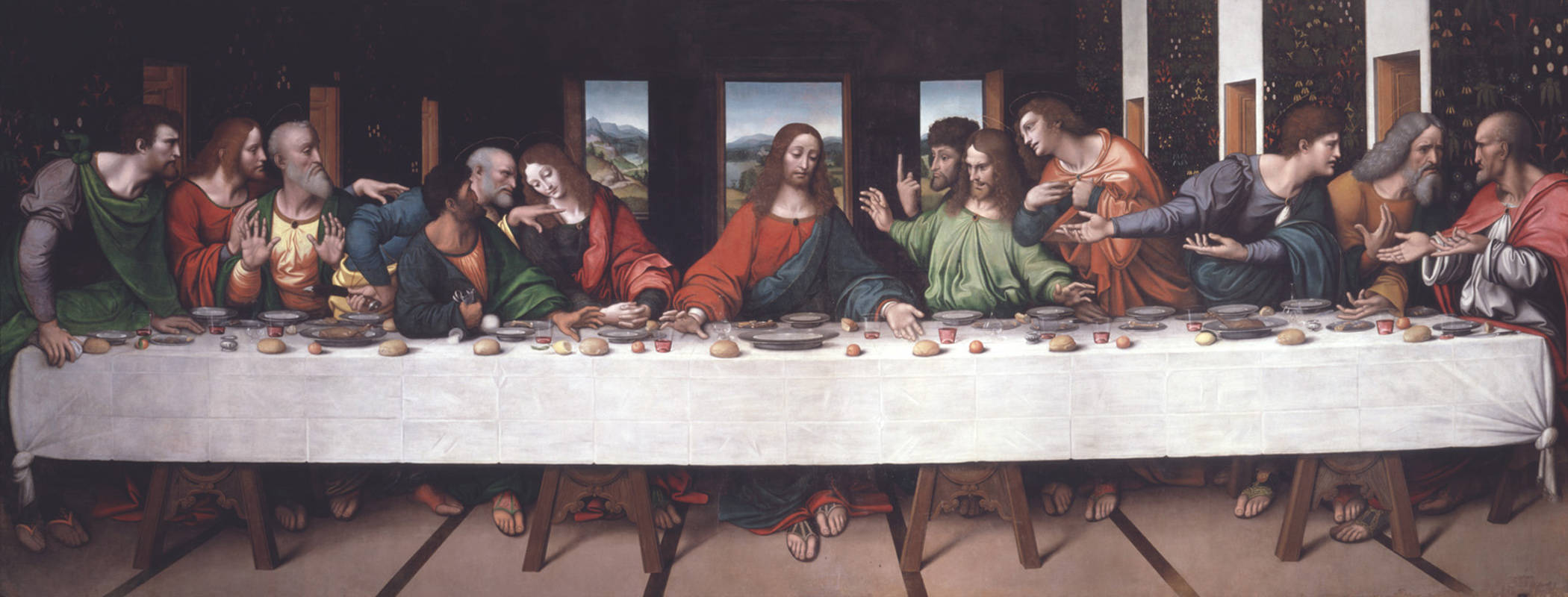
Firstly, as one of the leading figures from the ‘high Renaissance’, Leonardo’s work (not only paintings, but in general) pushed the boundaries – an example being the dissection of human bodies in order to understand nature and the human form. The consequence of this is that he had a sophisticated understanding of naturalism and the faces of the apostles are testament to this. They are interacting with Jesus and his revelation that one of them shall betray him (See Figure 1). Although upon a quick glance the superiority of Leonardo’s version is clear, Gaddi’s work must not be mistaken as completely unaffected by the Renaissance movement that had begun to gather pace in this period. His affiliation with Giotto clearly influenced some of the features of this painting. Under proper inspection the seemingly motionless faces without expression are far more naturalistic than the Byzantine faces of the past. What is amiss here, and what is evident in Leonardo’s last supper is the abundance of interaction between the figures. This, although considered superior, it is simply a different style. The art historian Heinrich Wofflin expresses that ‘in both styles unity is the chief aim’ and that ‘in the one case unity is achieved by a harmony of free parts’ and the other by ‘a union of parts in a single theme’[1]. Thus, the figures in Gaddi’s work may not be exemplifying Dante’s theory of ‘Visible Parlare’ but he certainly approached his portrayal of the figures in a highly sophisticated manner, as did Leonardo.

What is rather unconventional in Gaddi’s work is the illusion of the scene being in high relief, especially when other aspects of the painting (Judas’ diminution and portrayal of the evil as ugly and the good as beautiful) are traditional for the 14th century. (See Figure 2). The ambiguity of where the legs of the table meet the ground and the dark illusive background make it feel as if the image is protruding from the wall and expressed in the terms of Paolettii, ‘the painter has thrust the figures into space in front of the wall’.[2] In contrast to this, Leonardo adopts a ‘spherical perspective’ which the art historian Chastel asserts he is the credited inventor[3]. This play on perspective tricks the human eye into readjusting an image in order to retain the correct proportion. Therefore Leonardo’s last supper if considered in a flat perspective is arguably out of proportion; but because ‘we have an image of the world seen in a slightly concave mirror’[4] we naturally adjust the flat surface and replace it with a spherical surface therefore the proportion remains true. The two however, were clearly deviating from what was conventional in their respective time periods.

To conclude, both Gaddi and Leonardo clearly have different styles. However the misconception that Gaddi’s last supper is simply an older or degenerate style can be disputed. This is because Gaddi, although clearly influenced by what was accepted and popular in the 14th century, he began to experiment in the confines of what was possible in early renaissance art. This is comparable to Leonardo; even though he is clearly more advanced he was much the same in that he was too experimenting.


Figure 1: From left to right: Bartholomew, James son of Alpheus and Andrew are surprised; the following group of 3 include Judas who is notably clutching for his bag of silver whilst Peter holds a knife in anger (to represent the knife he used to cut off the ear of a Roman soldier) and John faints. To the right of Jesus is Thomas who appears upset, James the Greater who is in disbelief and Phillip who is pointing inwards and pleading for an answer whilst Jude and Matthew are turned towards Simon who appears to be shrugging.


Figure 2


[1] H. Wolfflin, Principles of Art History: The Problem of the Development of Style in Later Art (Dover Publications, 1986), 13.
[2] J. Paolettii, G. Radke, Art in Renaissance Italy (Laurence King, 2005), 93.
[3] A. Chastel, Leonardo on Art and the Artist (Dover Publications, 2002), 99.
[4] A. Chastel, Leonardo on Art and the Artist (Dover Publications, 2002), 99.